PETROGLYPS
Pre-Viking glyptic art by Steinn Stikkmann and other nailpoint engravers
Allan Krill, Professor of Geology
Trondheim, Norway
There are three main techniques for making petroglyphs: pecking, incising, and abrading. Here I use the term petroglyp for petroglyphs that were made by pecking with a hammer and nail. I use the word glyp for any engraved element of a petroglyp rock panel. A glyp may be a single point or a single line, not necessarily an image. The most common type of glyp in Europe is the cup mark, which I call a cup glyp.
I have been studying European petroglyphs for a few years. I distinguish the different artists and give them names, in the same way that geologists give names to rocks that they study and map. I now think that Steinn Stikkmann invented the nailpoint technique in Norway about the year 400 CE. Several other engravers —Ingi Innrisser, Oddr Omrisser, Tryggvi Tagger, Vemundr Vyg, and Belen Bego— probably learned the technique from seeing Stikkmann's work. They made petroglyps in many places —now known as Norway, Sweden, Denmark, Russia, Germany, England, Spain, Portugal, France, Switzerland, and Italy.
European petroglyphs have been misinterpreted for over a hundred years. See Helleristninger.com.
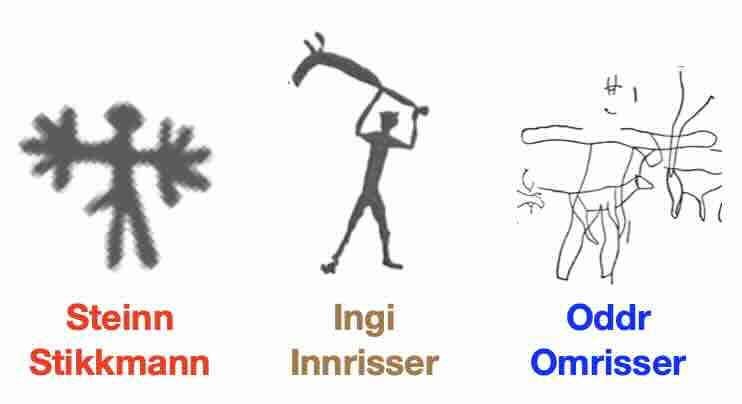
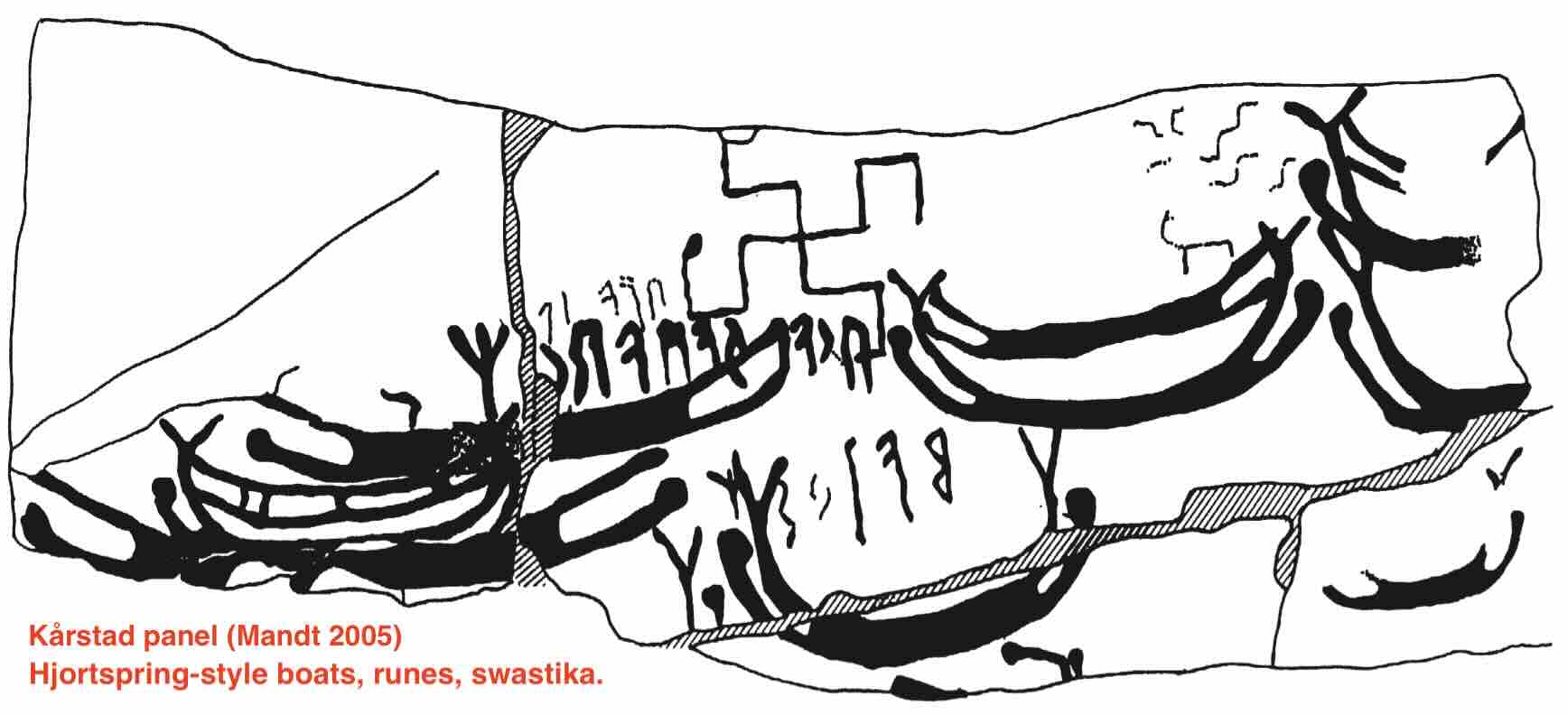
Steinn Stikkmann's petroglyps can be dated by runes that he happened to engrave. There are runes at eight of Stikkmann's sites: at Stuberg, Ytterøya, Tessem, Kårstad, Myklestad-Tysnes, Askum, (Tanum 441?), Herrestad, and Himmelstalund. Except for Kårstad, the runes are undeciphered, and some may have been meaningless. They show characters of the Elder Futhark alphabet, which was in use about 400 CE.
Stikkmann also engraved a swastika —an Iron Age symbol— at Stuberg, Bjørngård, Herdlevær, Inderøya, Kårstad, Tossene, Svarteborg, and Askum. He made two swastikas of his own special design at Askum in Sweden. Then he made them in England, Portugal, and Valcamonica Italy. Those swastikas are known in Italy as Camunian roses. Since his runes can be dated to about 400 CE, the petroglyps by the other nailpoint artists must be somewhat younger.
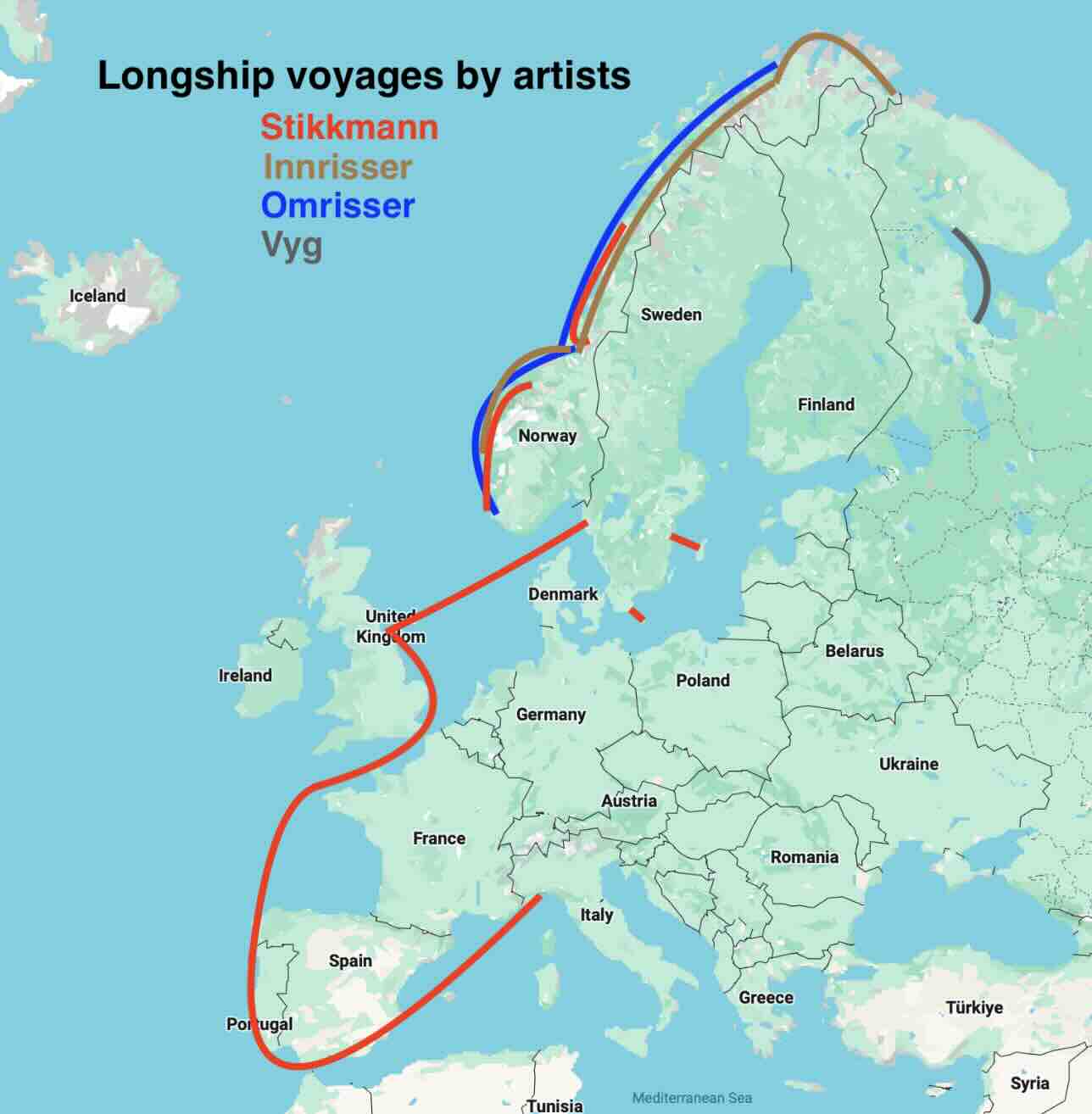
Stikkmann, Innrisser, Omrisser, and Vyg all showed longships with animal-head prows, which were probably precursors of Viking dragon-head prows. Captains in some of Stikkmann's boats are wearing Viking-style helmets with horns. The petroglyps were surely made before 800 CE, because Viking longships had sails by then. The Viking Age is said to have begun about 800 CE, but petroglyps show that longship voyages were being taken 400 years earlier, in what archaeologists call the Nordic Roman Iron Age. Scandinavians traded iron and amber for bronze and other goods from the Roman Empire.
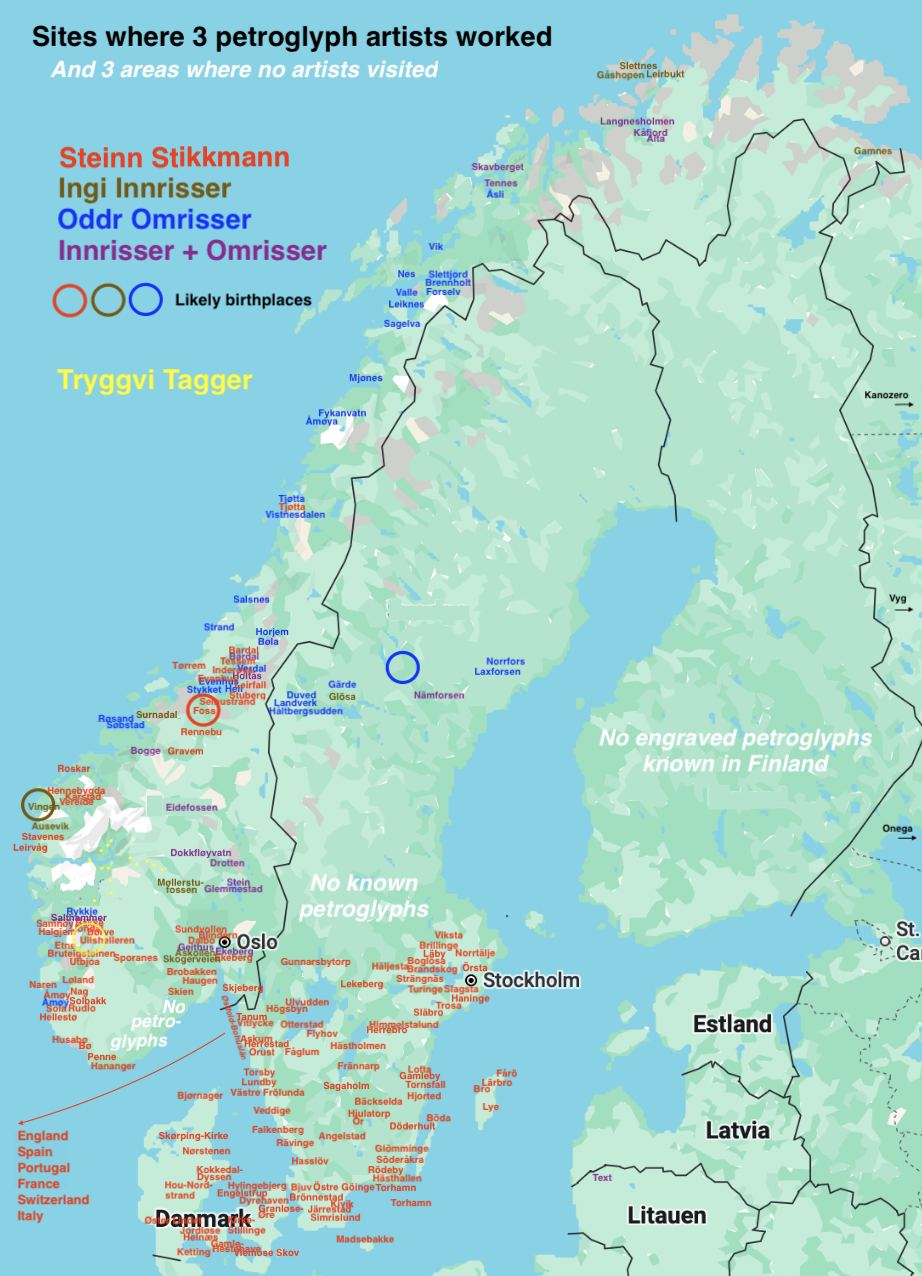
It is possible to consider the skills, motifs, and locations of the petroglyps, and speculate about the artists' careers and travels. I explain my current interpretations here. In the blog links at the bottom of this page, I explain my hypotheses and discoveries over the past three years. I tend to write my interpretations with few hedge words, as if they are certain. But all my hypotheses are subject to change. (In art history, even some 'facts' are hypotheses.)
Steinn Stikkmann: The primary petroglyp artist of the Roman Iron Age in Scandinavia and Late Antiquity in Italy
(If your main interest is Stikkmann, you will find the same information, without Innrisser, Omrisser, etc, at Stikkmann.com)
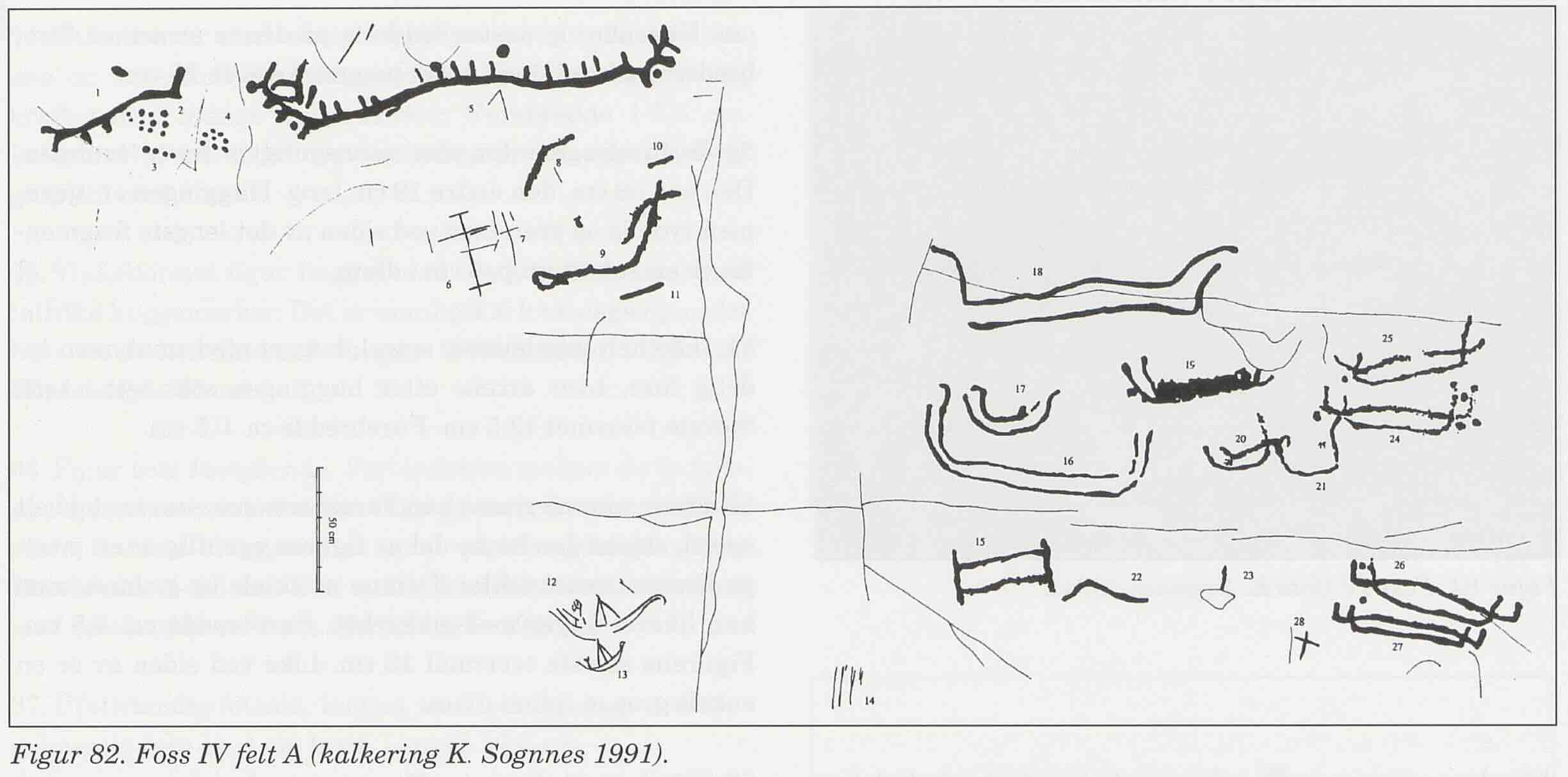
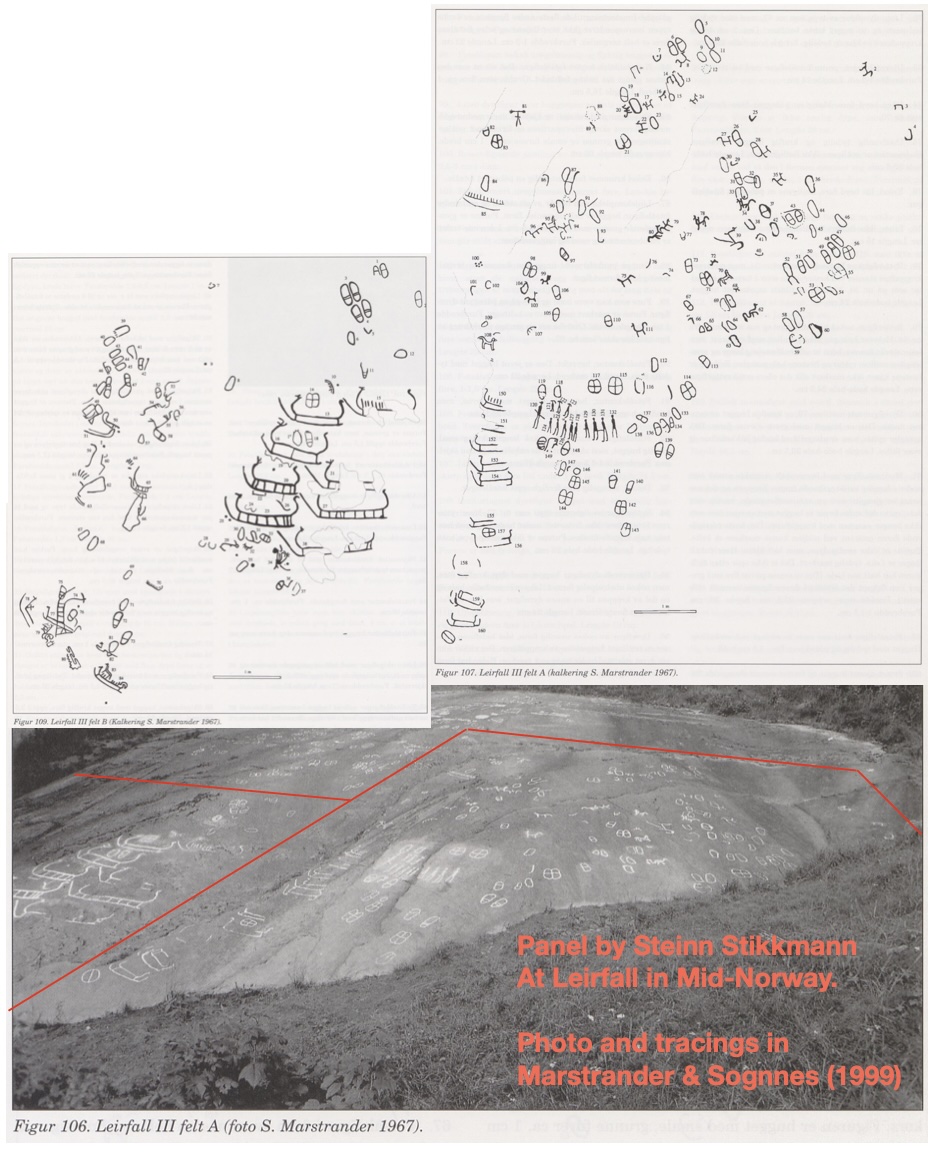
Steinn Stikkmann discovered how to use a nail as a stabbing tool (stikkvåpen) to peck the soft rocks in Gauldalen, central Norway. He practiced nailpoint engraving by making round cup glyps (cup marks) and shoe prints that never show a pattern of walking. He also tried incising with the point of a knife. Archaeologists have noted that the petroglyphs in Gauldalen are relatively crude. One of his first figurative panels, with boats and cup glyps, is seen below (Fig. 82 in Marstrander & Sognnes 1999).
Stikkmann's favorite motif was boats. He drew some symmetrical longships with two extensions fore and two extensions aft, like the Iron Age boat that was buried at Hjortspring, Denmark in about 350 BCE. But most of Stikkmann's boats were more seaworthy, with high bows and sterns. He drew over a thousand of them in Norway and Sweden. Most of the boats are asymmetrical, with long keel-extensions fore and short keel-extensions aft. They are said to be Bronze Age boats from before 500 BCE, but they could have been in use in the Iron Age about 400 CE. Curiously, Stikkmann never indicated water or the water line. He showed the complete hull of each boat, including the parts of the keel extensions that would be hidden under water.
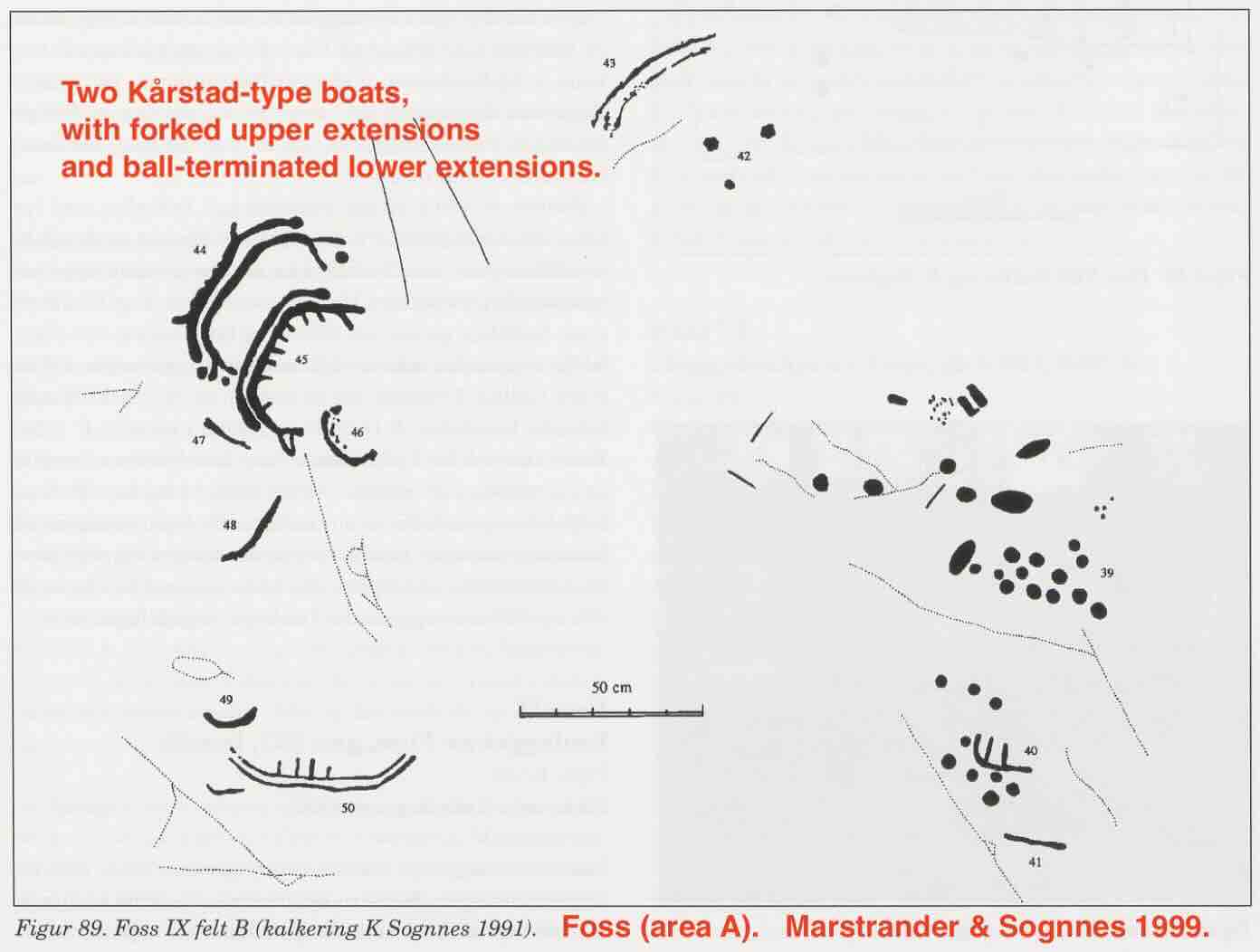
Stikkmann's art is highly stylized and very consistent. He drew slimline horses, men with long thin legs or exaggerated calf muscles, and small round heads on long thin necks. When he showed arms, they were usually up in the air and the hands had outstretched fingers or were holding something. He often drew penises on his men —sometimes a penis and scrotum, but often looking like a knife, sword, stick, or extraneous line. He used a ponytail hair style to indicate women. He exaggerated some things, such as extra-long longships with over a hundred crew members. The pairs of crewmen are usually shown simply as vertical glyps, but sometimes with round heads. At a few sites he showed the men in more detail, holding paddles. In some ships he added two or three giants that tower over the other men in the boat.
Stikkmann's petroglyp sites show where he traveled. I think he started at Foss in Gauldalen where he made cup glyps on over 50 panels. Foss was an important settlement in 400 CE, with a bog-iron smelting facility. Because of the dangerous rapids (foss) on the Gaula River, the chief of a travel station there could serve people traveling along this major inland route through Norway. Archaeologists have found a chief's burial site at Foss containing artifacts of gold. Steinn Stikkmann may have been a chief's son, and learned runes from an educated traveler. I imagine that young Steinn was inspired by travelers' tales, and the strange dialects of people from southern Norway, Sweden, and Denmark. As an adult, he became one of the greatest travelers of his time. He made petroglyps in Norway, Sweden, Denmark, Northern Germany, England, Galicia Spain, Portugal, the Western Alps of France and Italy, and the Eastern Alps of Switzerland and Italy.
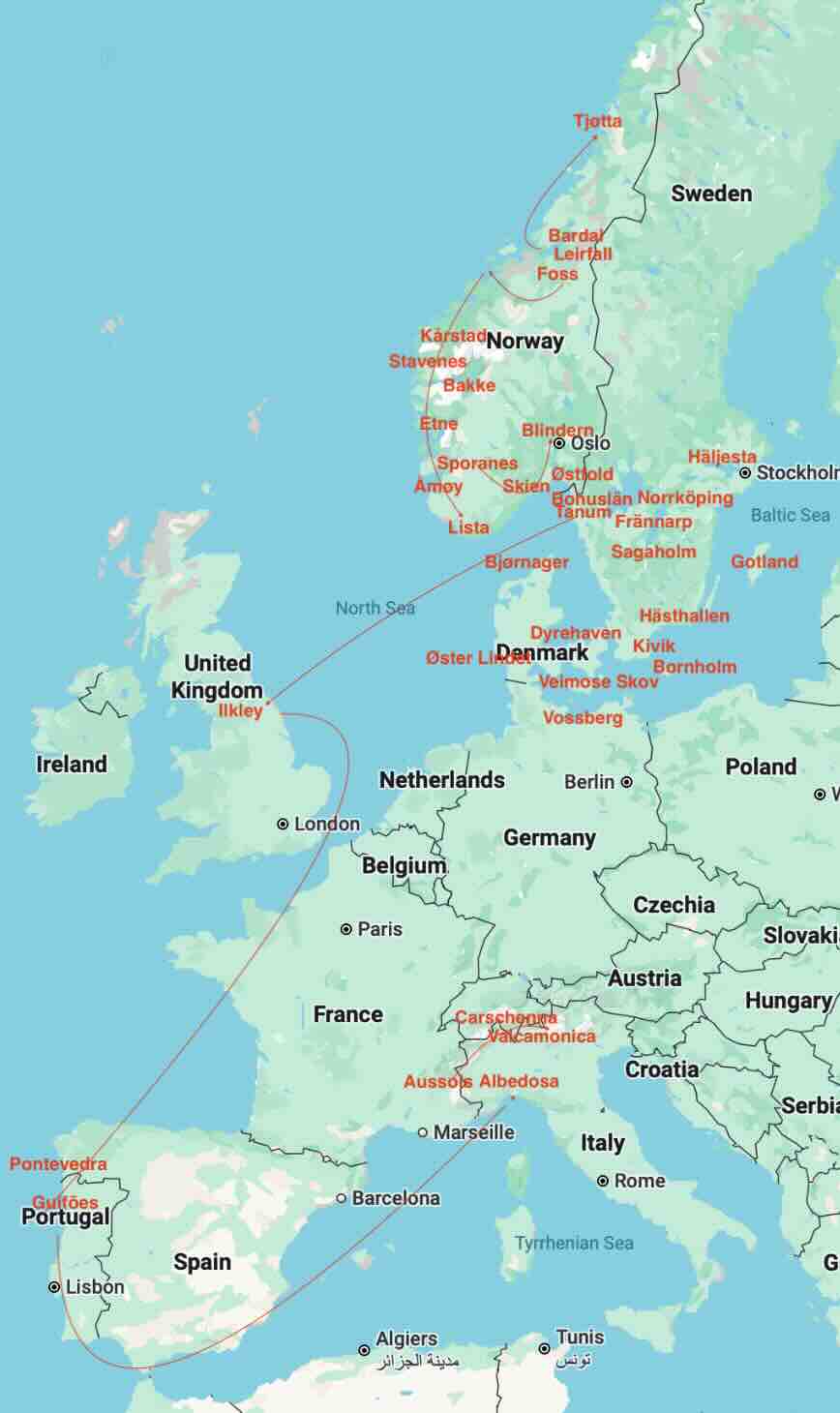
From Foss, Stikkmann went via Gauldalen to Selbustrand where he found boulders of granite that had been carried by glaciers from Sweden and deposited during the Ice Ages. I think he was impressed with the qualities of granite, which is practically nonexistent in the bedrock of central Norway. He engraved petroglyps on many of the boulders. He then went to Trondheimsfjord, where he may have stayed for a few years. He made petroglyps at dozens of sites between Stjørdal and Steinkjer. He worked near farms and along paths between farms. During that time, he hopped on a boat and took a trip north to Tjøtta, which was an important settlement in the Viking Age and in pre-Viking times.
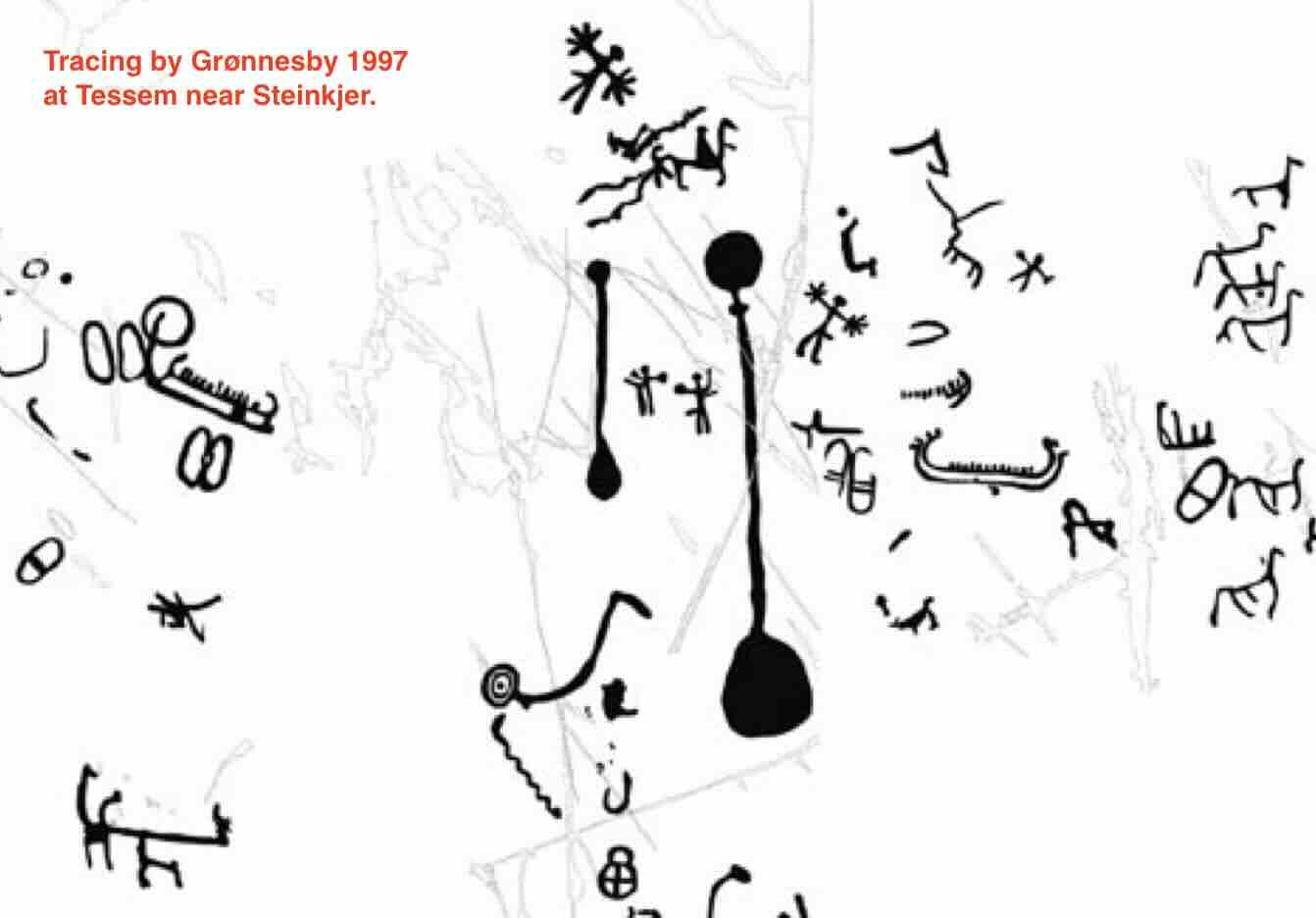
Below is a typical panel by Stikkmann at Tessem near Bardal. Note the shoe prints, two cup glyps, slimline horses, and two phallic men with outstretched arms and exaggerated hands. There are two of his typical boats —one with 10 crewmen (or 20 if each glyp represents a pair of paddlers) and the other with 15 (or 30). Another panel nearby shows Elder Futhark runes and a boat.
Stikkmann left Trøndelag, central Norway and began a great journey, maybe searching for bedrock panels (not just boulders) of granite. I think he began at Foss in the spring, and walked to Rennebu and Oppdal. He made only a few petroglyps on this part of his trip, maybe because there was still snow on the ground. He avoided the high snowy mountains of Dovrefjell by walking west to Gravem and out to the fjords. Then he traveled mostly by longship around the coast to Kårstad, Bergen, Stavanger, all the way to the southern tip of Norway. He did not continue further east along the coast —no petroglyph has ever been found in Aust-Agder. Instead, he made a U-turn and went back to Stavanger and then traveled inland to Røldal and Sporanes to Skien. From there he went wide around Oslofjord and then came to the Østfold-Bohuslän area.
Stikkmann probably spent many years in the Østfold-Bohuslän area, working with the Bohus Granite. He made petroglyps on thousands of rock panels there. The Bohus Granite was ideal for his petroglyps. The granite panels are especially hard and smooth, with no layering and relatively few fractures. Geologically, it is the youngest and freshest granite in Sweden. (Gustav Vigeland used it to carve the monolith and statues in Frognerparken in Oslo.)
There are no petroglyphs on the small islands of Bohuslän. Many of the sites were islands in the Bronze Age but are not islands today, and were not islands in 400 CE when Stikkmann was working there. That shows that Stikkmann walked from site to site, and did not use a boat. If the petroglyps had been made in the Bronze Age, the sea level would have been higher and boats would have been needed to get to many sites. If boats had been used, petroglyps would also have been made at places that are still islands today.
Stikkmann went far beyond the Bohus Granite, searching for other good-quality rocks and rock panels. He didn't yet know that the Bohus Granite was the best in Sweden. He explored much of central and southern Sweden, and the islands Orust, Öland, Gotland, and Bornholm. He walked along the north side of Mälaren, a bay of the Baltic Sea. He preferred that area's hard quartz-rich gneiss for his engravings (see Löfstedt & Löwenborg 2025). He did not visit islands in the Mälaren bay, which shows that he walked to sites and did not use a boat.
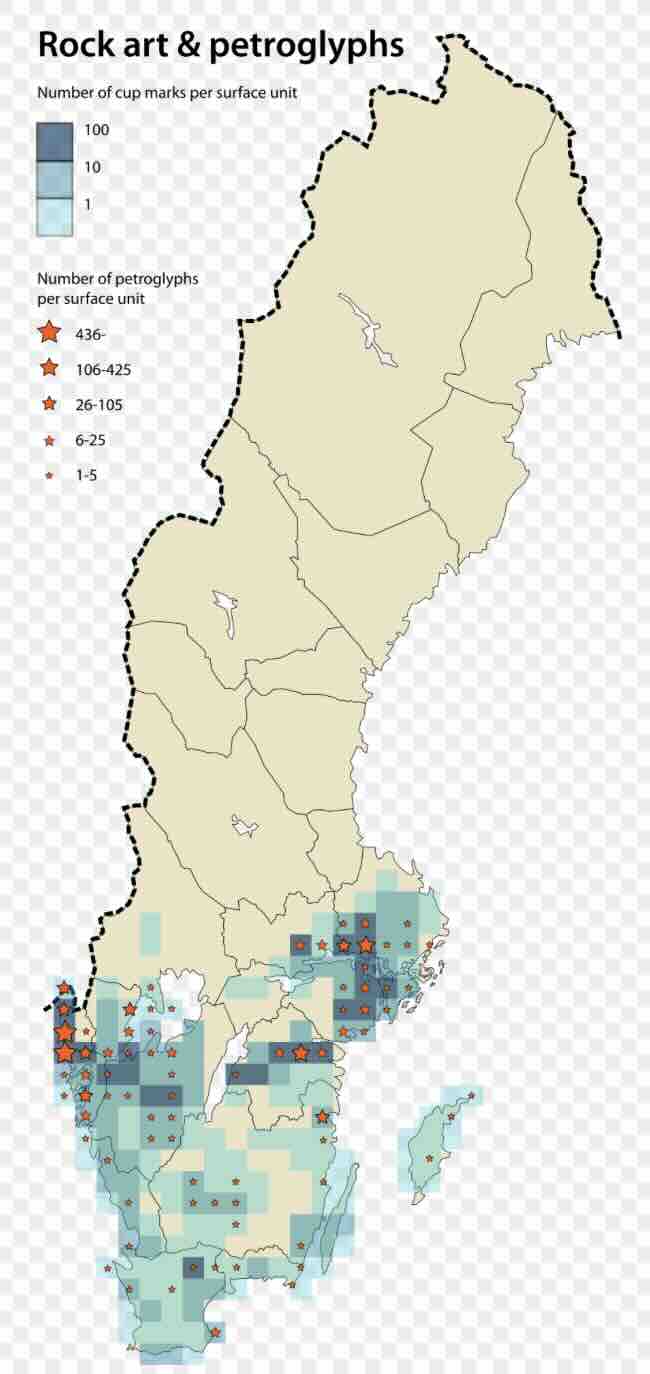
The map below from The National Atlas of Sweden shows the distribution of petroglyphs and cup marks registered before 1994. Curiously, the eight sites in northern Sweden (engraved by Omrisser and Innrisser) are not shown. The complete absence of cup marks in central and northern Sweden suggests that Stikkmann never went to northern parts of Sweden.
I suppose that Stikkmann owned no house or property, and that owners of large farms gave him room and board wherever he went. Being educated (able to read runes) and speaking with a strange dialect, he was probably a welcome house guest. He could enrich people's lives by telling of faraway places, and by leaving his art. His work must have been appreciated, because he was asked to engrave rock slabs for the monuments at Sagaholm and Kivik.
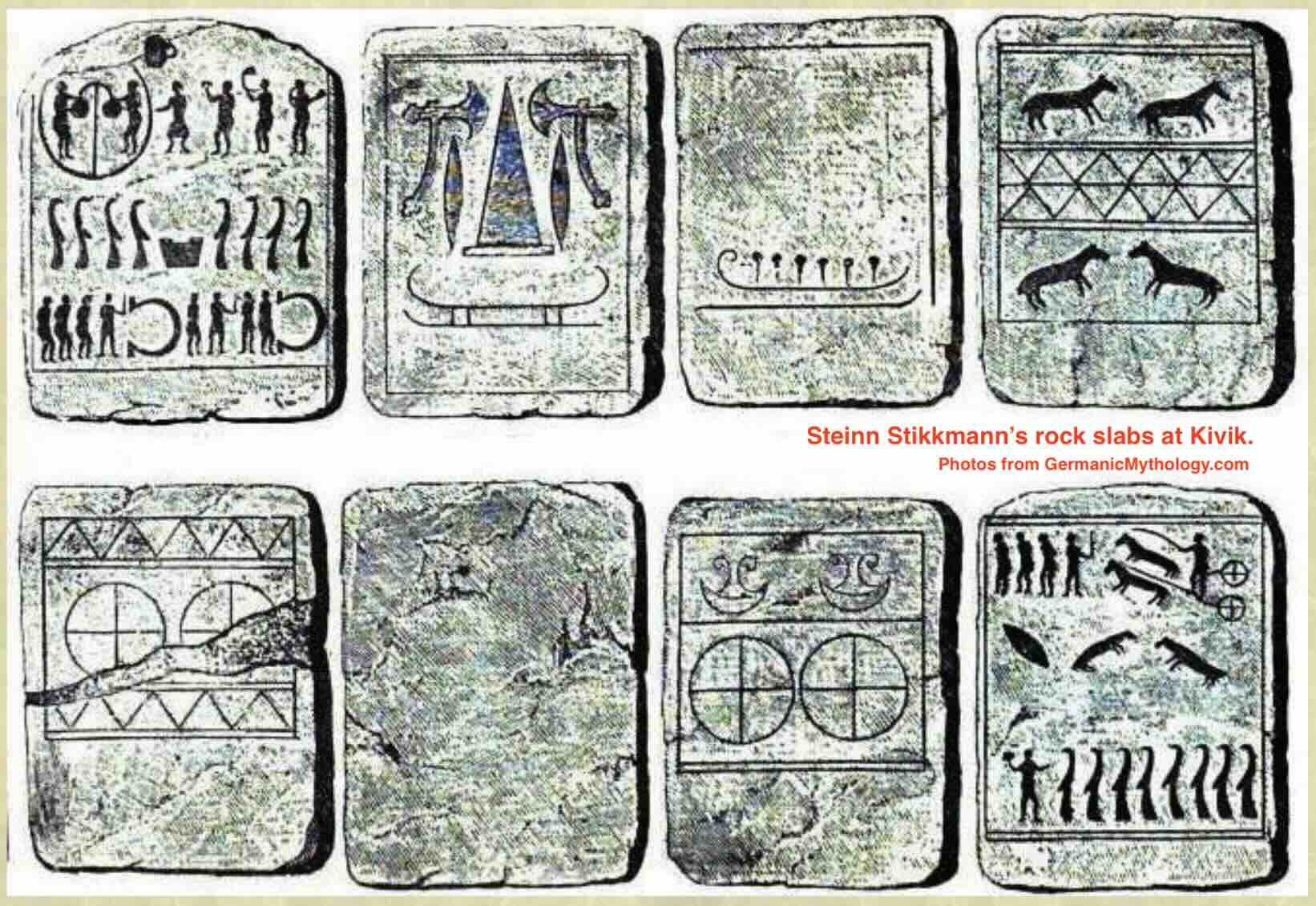
I think at Kivik he was shown a Bronze Age-style axe, or a detailed drawing of that special axe shape, and he carefully reproduced it for an engraving (see the pictures below). After that, he drew versions of that axe type in Bohuslän. His images of axes helped convince Oscar Montelius, the most influential Scandinavian archaeologist, that the petroglyphs were from the Bronze Age. But Stikkmann drew the images in the Iron Age. Drawings of objects, and even bronze objects themselves (such as the Trundholm model horse and chariot) can give false old ages. (That item may have been Viking plunder that was disposed of in a bog.)
A few other people probably tried engraving. I think the famous maypole at Tanum was engraved by someone else. If there had been many petroglyph engravers, I think we would see practice panels where new beginners were learning about rock panels and tools. Wall art by inexperienced artists cannot be erased or hidden. Also, if there had been many engravers, there would be other artistic styles and motifs, such as boats in the water, full-bodied horses, and footprints showing walking. Other artists would have their quirks that would help us to identify them.
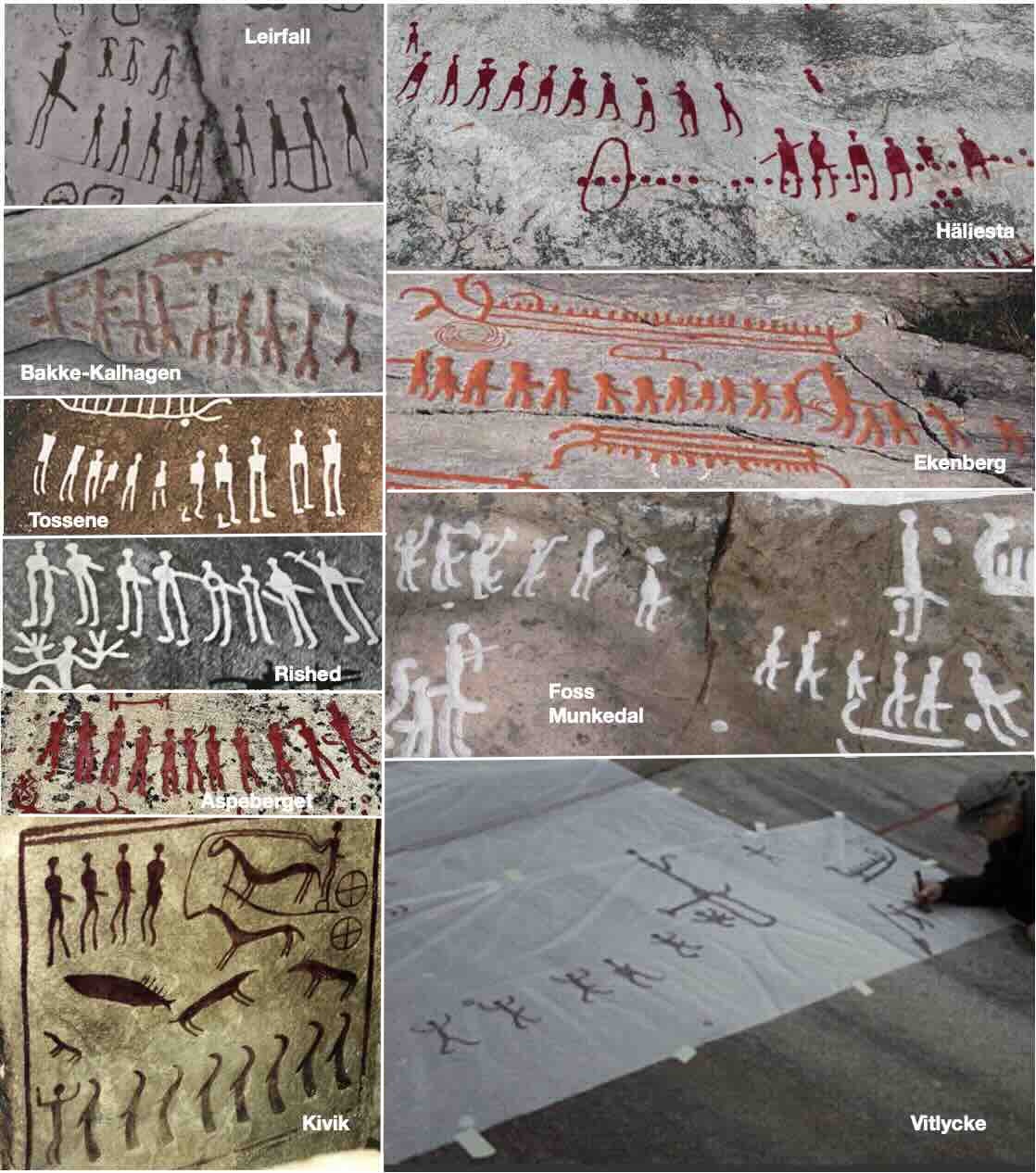
One of Stikkmann's special motifs was two horses pulling a chariot, which he engraved at Staveneset and Begby in Norway, and then at many places in Sweden. He also liked to show processions of men (most without arms.) He engraved his first processions at Leirfall and Bakke-Kalhagen, and then at many places in Sweden.
When Stikkmann encountered rock types and rock panels that were of poor quality, he made mostly cup glyps, not figurative glyps. We see that from his visit to Orust where Bohus Granite is absent. There he engraved 2175 cup glyps on 192 rock panels. The only figurative images are 35 footprints, 4 boats, and 3 humans. In Denmark, where there are no large rock panels, he made thousands of cup glyps and almost no figures.
Stikkmann wandered all around Denmark, looking for hard bedrock panels to engrave. He must have eventually realized that there is no bedrock exposed anywhere. Soft sedimentary rock layers cover the entire country. He did find large stones. Except for flint nodules, the stones in Denmark were brought there by Ice Age glaciers from Norway and Sweden. He tagged over 500 stones with cup glyps, but made very few figurative engravings. About 30% of the stones he chose had been arranged or stacked at Bronze Age graves. Stikkmann typically tagged the capstone or some other prominent stone.
A few thousand Bronze Age graves still exist in Denmark. The association of cup marks with grave monuments reinforced the incorrect belief that the petroglyphs of Denmark and Sweden are Bronze Age artifacts. The archaeologist P.V. Glob (1969) estimated that only 4% of the monuments have a cup-marked stone. He concluded that cup marks were unrelated to the graves themselves, but were made for some unknown purpose.
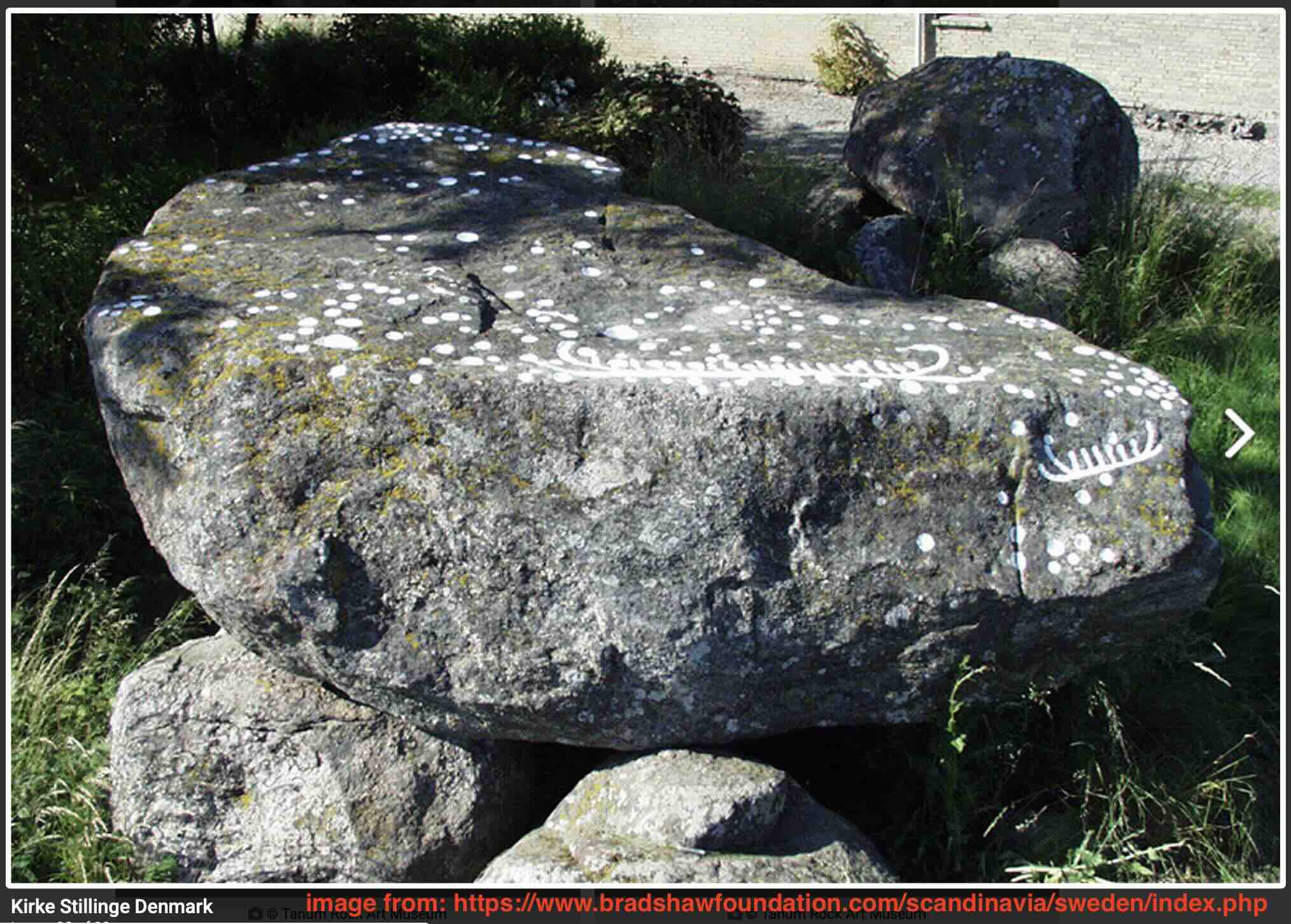
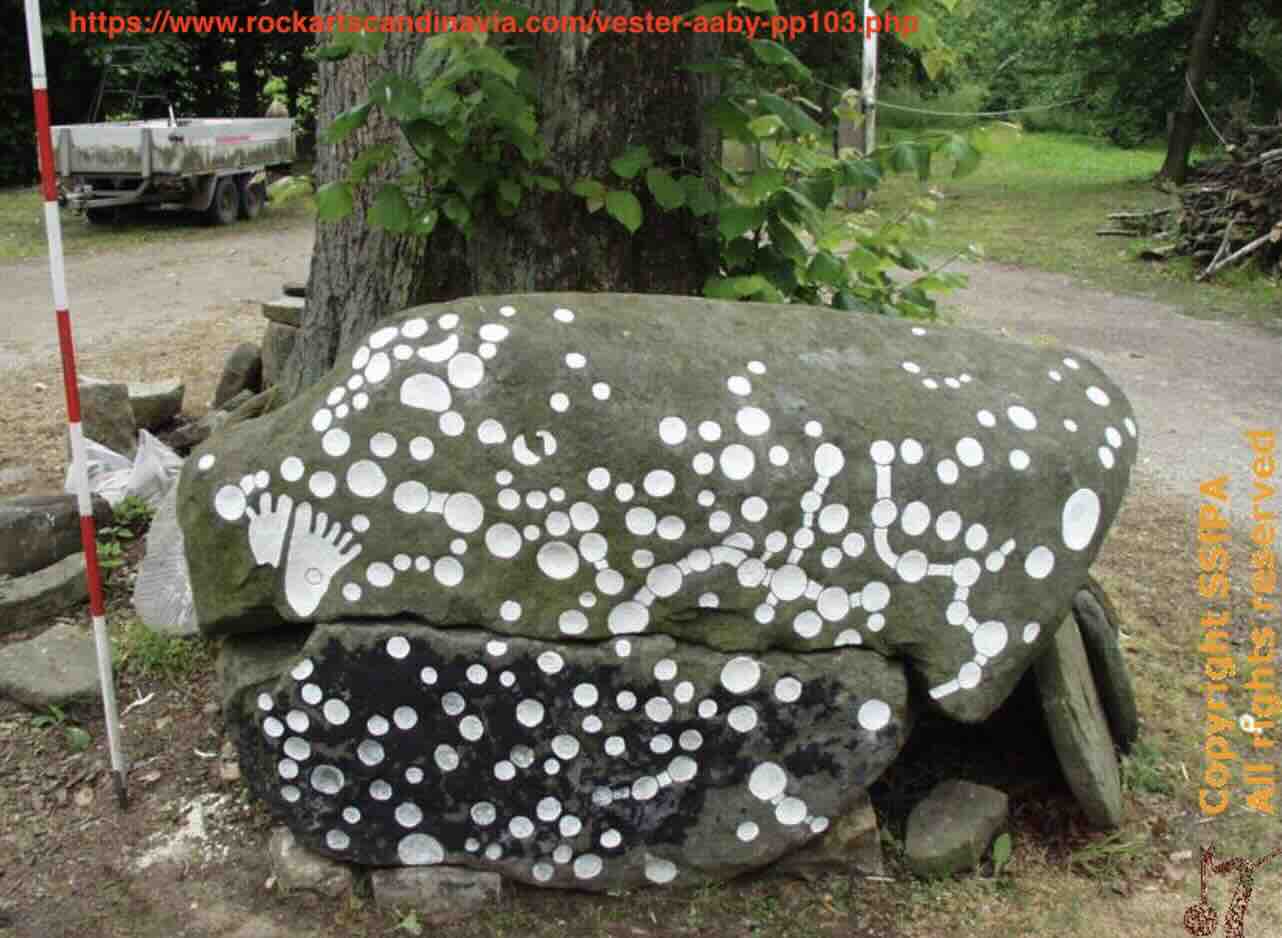
Stones with cup glyps in Denmark that also have a figurative image. White chalk was used to mark the engravings.
Late in life, Stikkmann left Bohuslän and traveled by longship all the way to Italy, where he worked at many sites from Aussois in the Western Alps to Valcamonica in the Eastern Alps. On the voyage there, he made an engraving of his Camunian swastika (with four lobes that loop around nine cup glyps) at Ilkley West Yorkshire England, and another at Castro de Guifões Portugal. He also made many other petroglyps near those places.
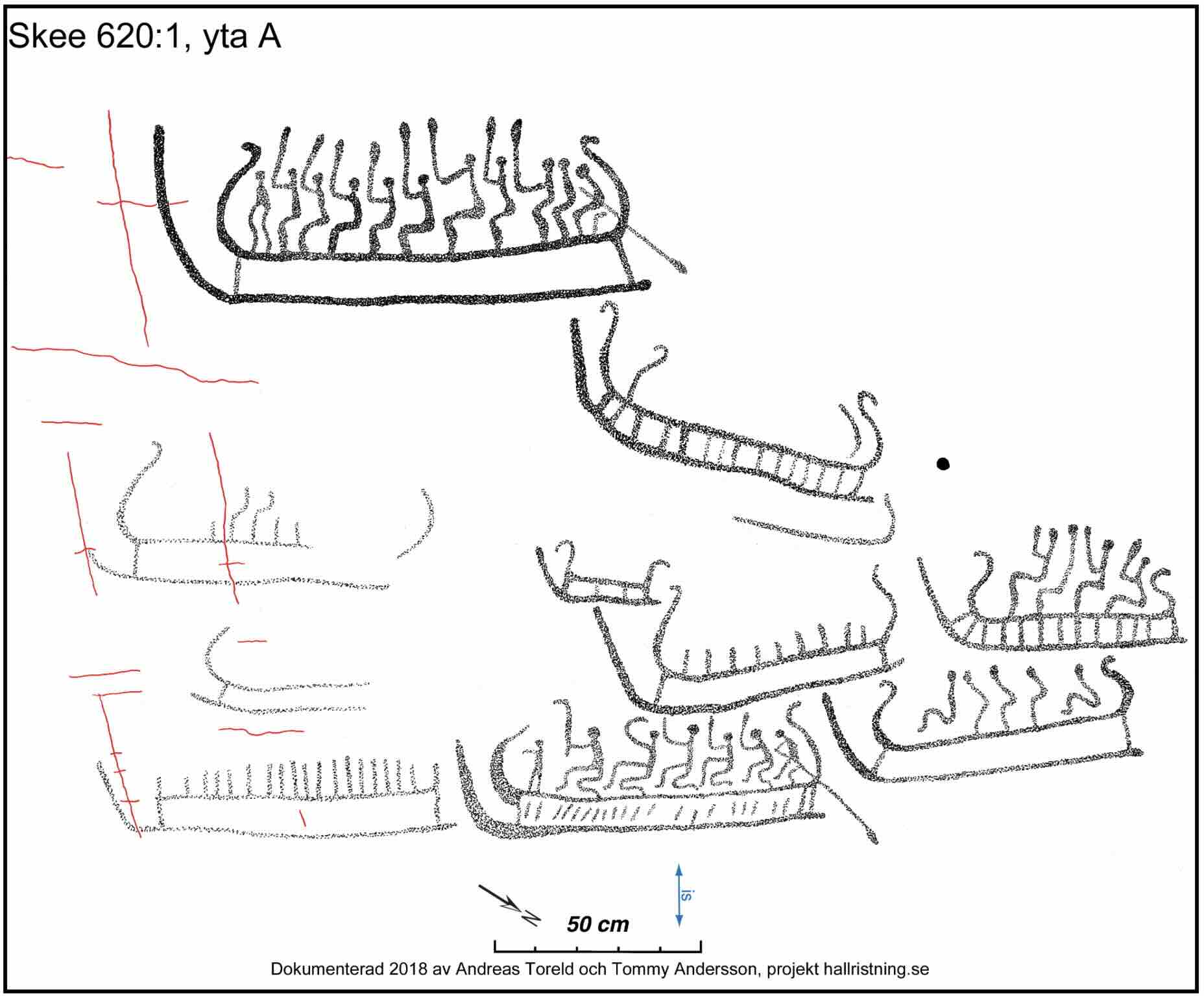
Raä Skee 620 in Bohuslän. Fleets of boats routinely went on long journeys during the petroglyph times. The travelers may have been trading Nordic amber for Mediterranean bronze.
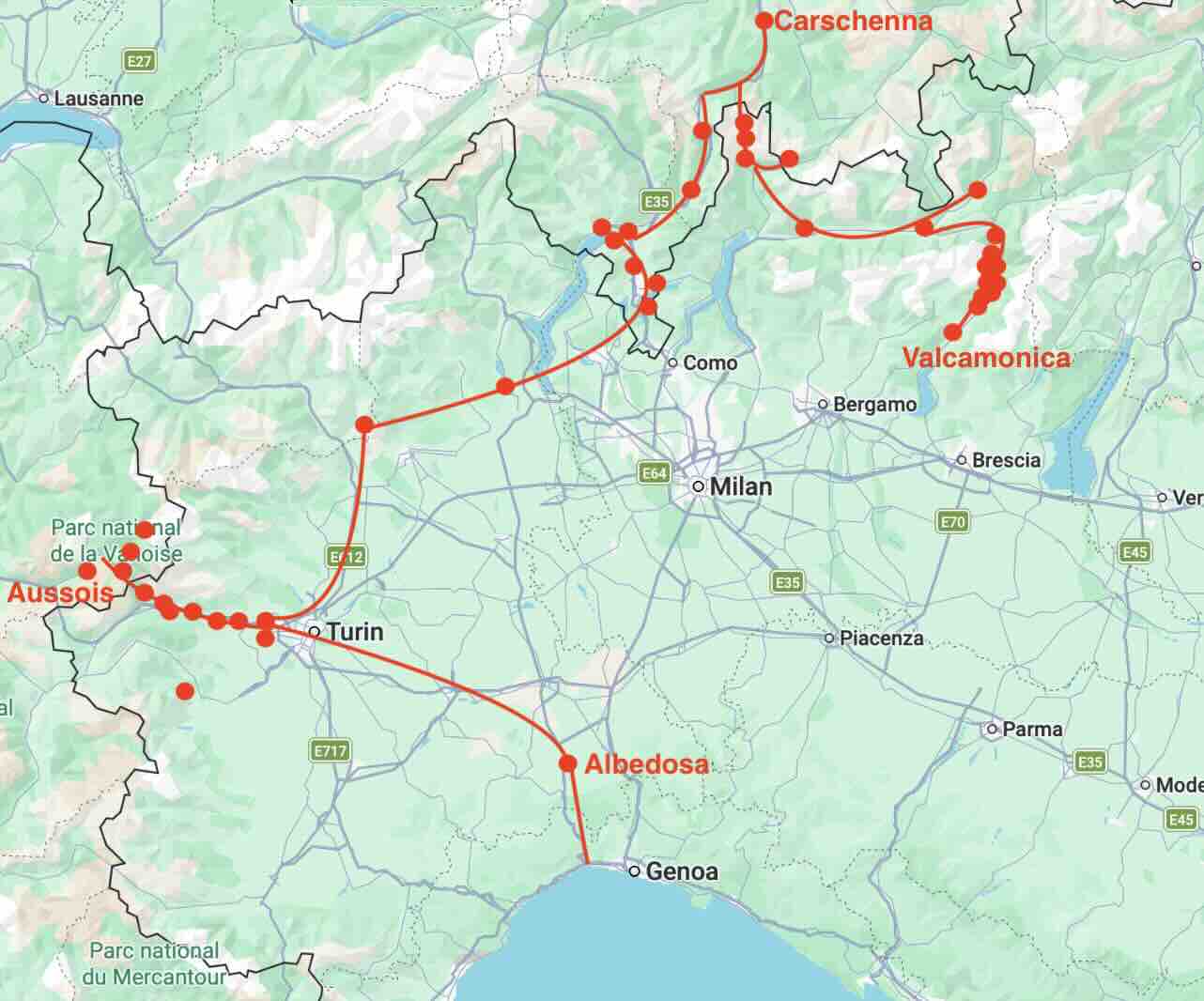
Stikkmann's apparent travel route in the Alps, based on the locations of cup glyps and shoe prints.
Stikkmann made no boat engravings at Valcamonica, Italy, and he never returned to Scandinavia. I think his boat-obsession became a boat-aversion after his 6000 km-long sea voyage. He drew paddles in Galicia Spain and at Valcamonica. They seem to be randomly placed and unrelated to other images, like his cup glyps and shoe prints. They may have been inspired by longship paddles or rudders.
Stikkmann repeated many of the special motifs that he had engraved in Bohuslän. There are hundreds of cup glyps, hundreds of shoe prints, Camunian swastikas, men with small heads, long necks, and arms up, men with spears, dueling men, men standing, not sitting, on horses, plowing scenes, standing birds, dogs chasing deer, deer with visible penises, and more.
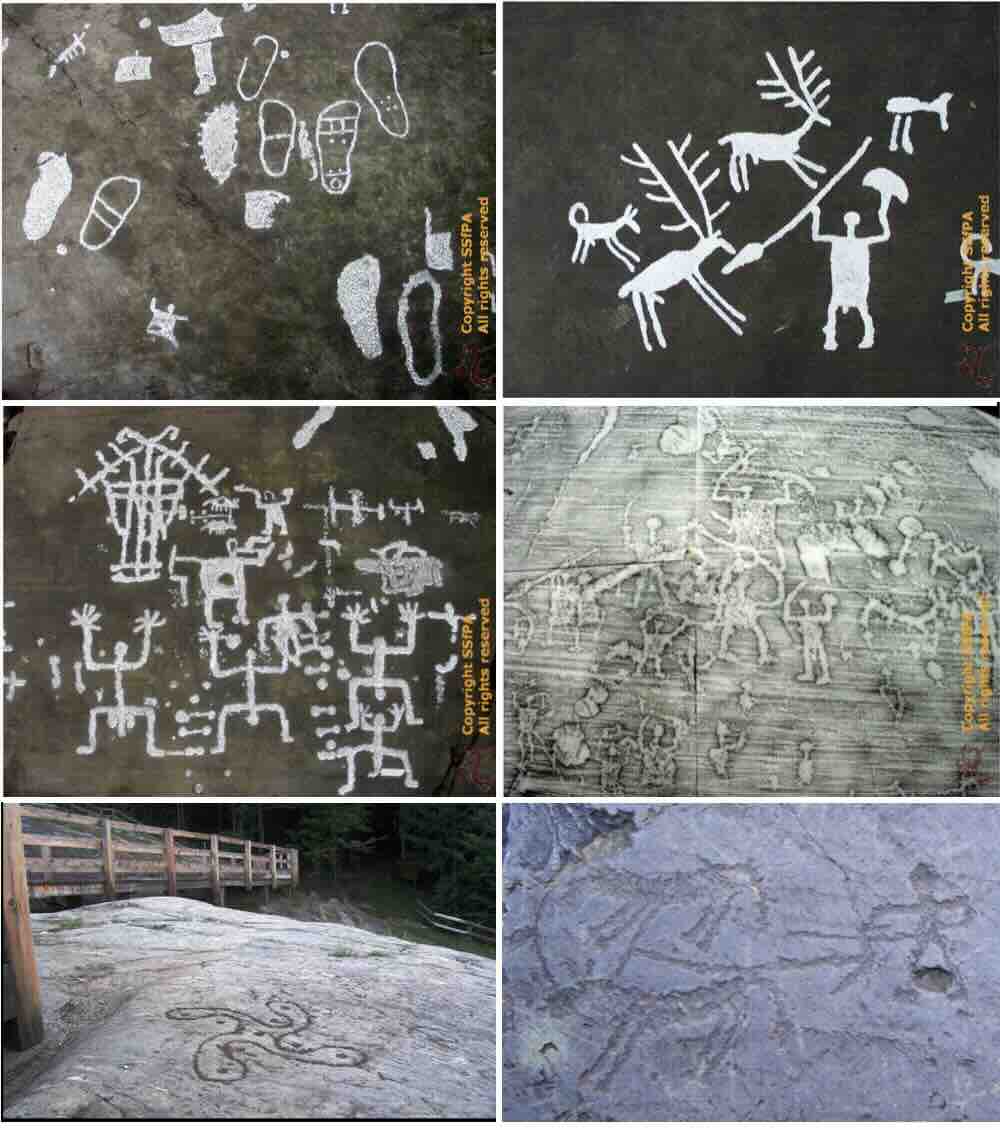
Valcamonica photos: four from the website of Underslös museum and two from Wikipedia.
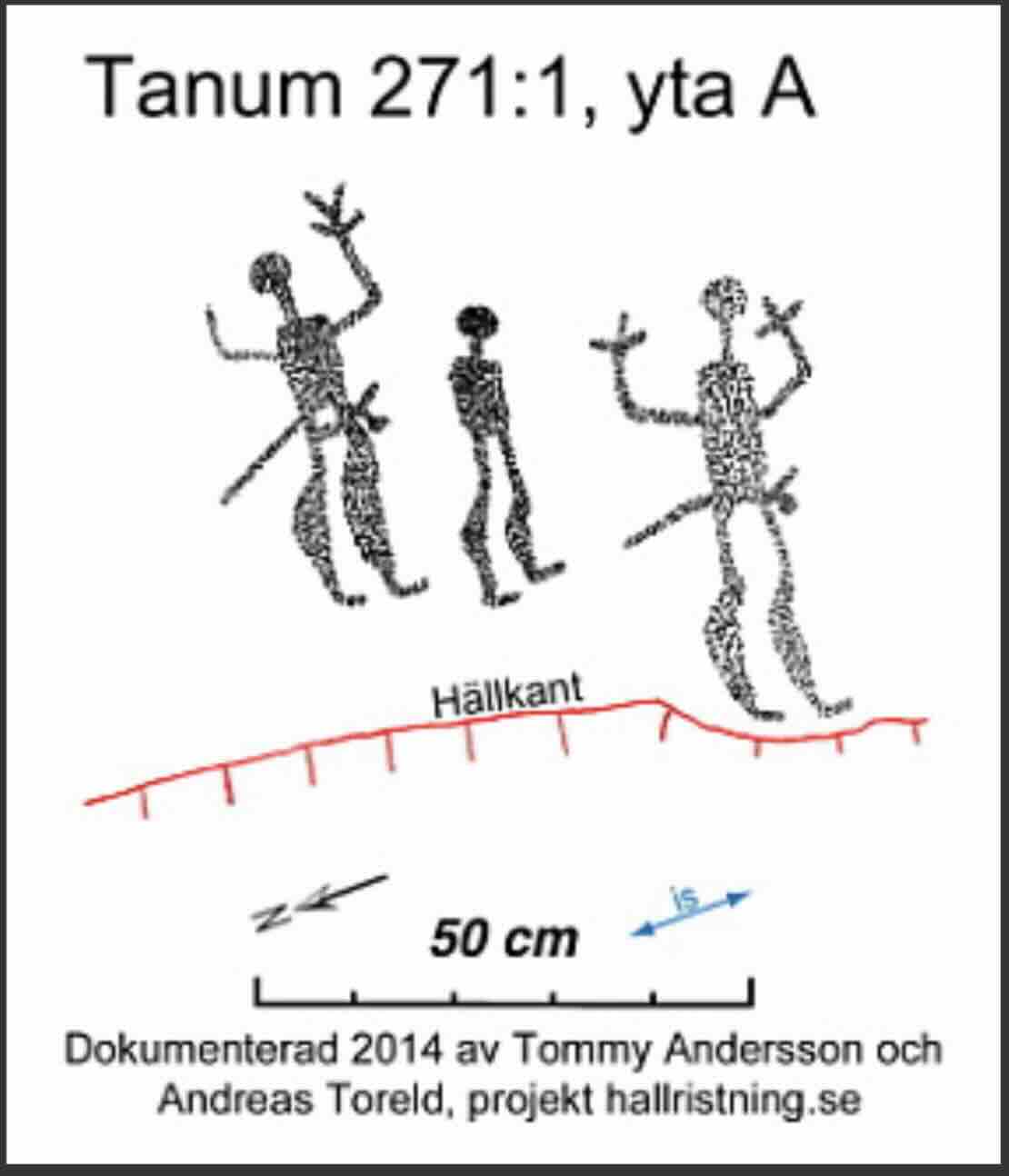
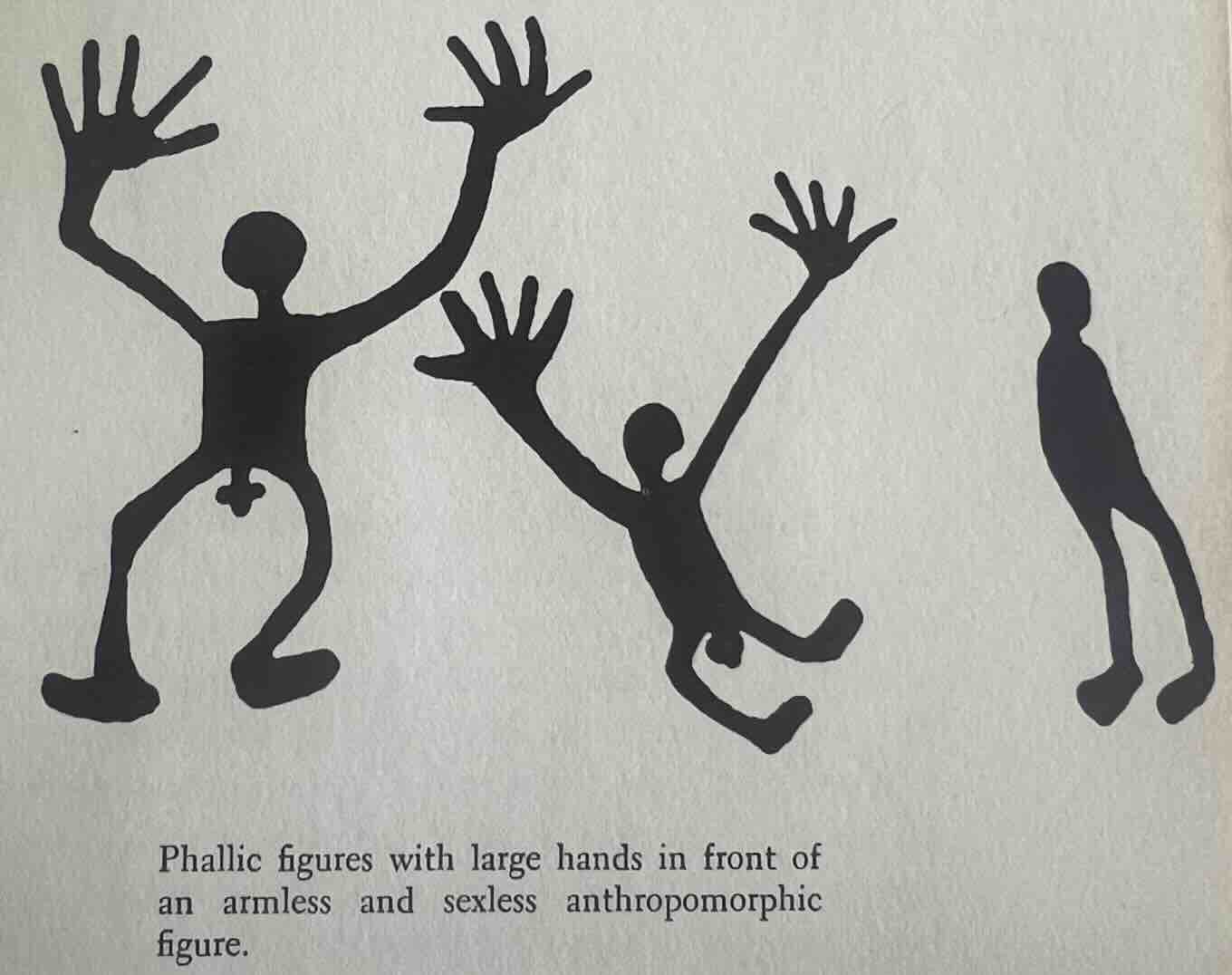
Stikkmann's phallic men in Scandinavia are said to indicate a fertility cult, and at Valcamonica they are said to indicate ithyphallic deities. But showing penises, and the arms-up-fingers-spread pose, were probably meant to indicate vitality and power. Stikkmann engraved the motif of two powerful men and one powerless man, first at Tanum and then at Valcamonica.
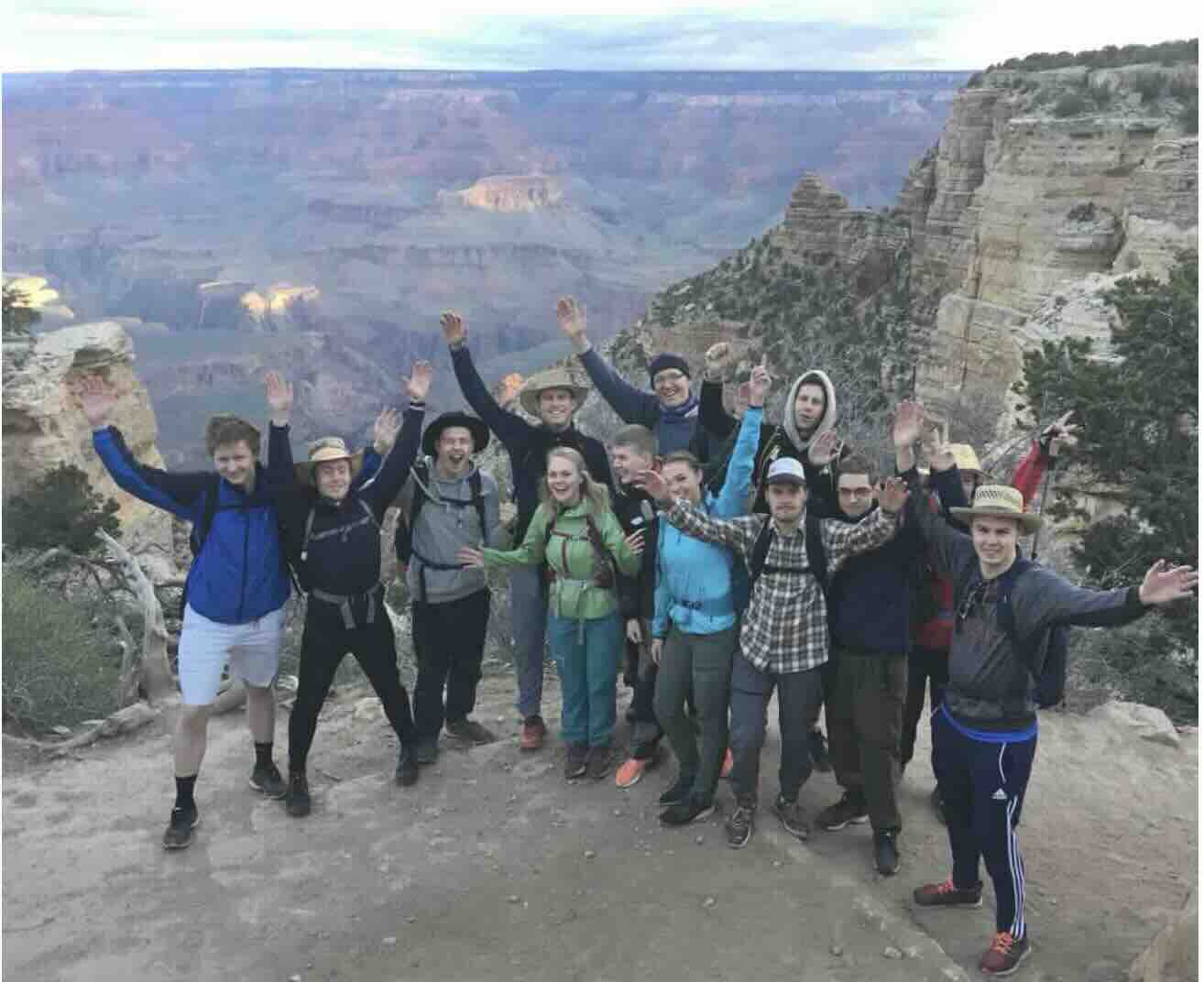
Left: Norwegian students at Grand Canyon USA, 2019 CE.
Center: Norwegian artist's petroglyps at Tanum Sweden, ca. 400 CE
Right: Norwegian artist's petroglyps at Valcamonica Italy, ca. 400 CE.
Many of the images at Valcamonica are not as precisely engraved as those in Sweden. Stikkmann continued to make petroglyps at Valcamonica after he lost the interest or the ability to engrave precisely.
Some of his last engravings were images of buildings, which he had never drawn in Scandinavia. The buildings are distinctively Norwegian or Scandinavian, not Italian or Alpine. They are wooden loft buildings with a narrow ground floor and a wide upper floor with an external stairway. They have typical Nordic sod roofs with grass growing vertically. Sod roofs would dry out and not function in Italy or the southern Alps. Loft buildings were used at Nordic farms for storage and for guests to the farms. A loft building from year 1167 CE still exists in Norway. Stikkmann had probably stayed in lofts while traveling in Norway and Sweden, and at Valcamonica he drew many of them.
To carefully study some of Stikkmann's engravings at Valcamonica, I recommend the Naquane Great Rock Virtual Tour.
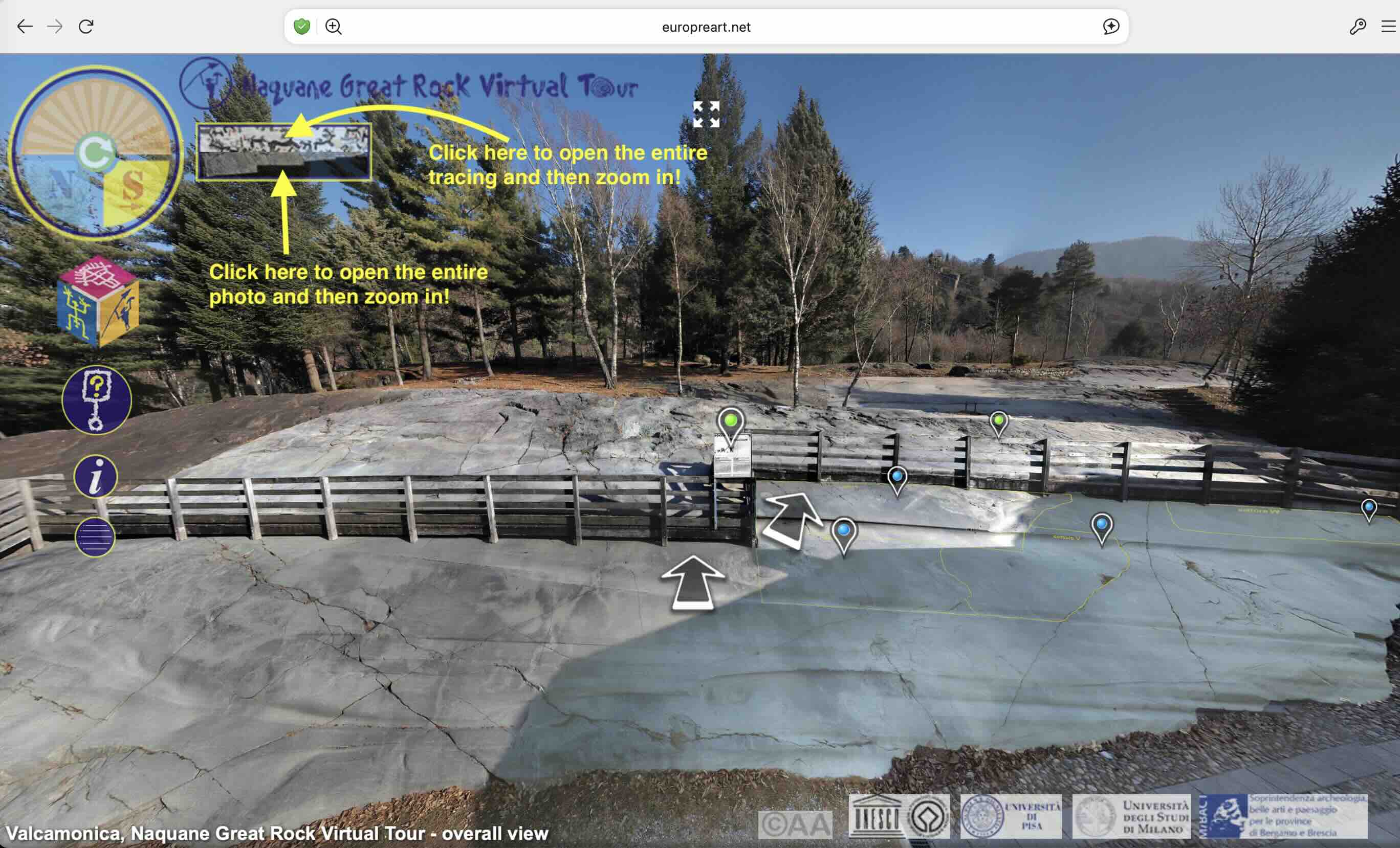
https://www.europreart.net/NAQ1/fullview/NAQ1_tour_full.html. My notes in yellow added.
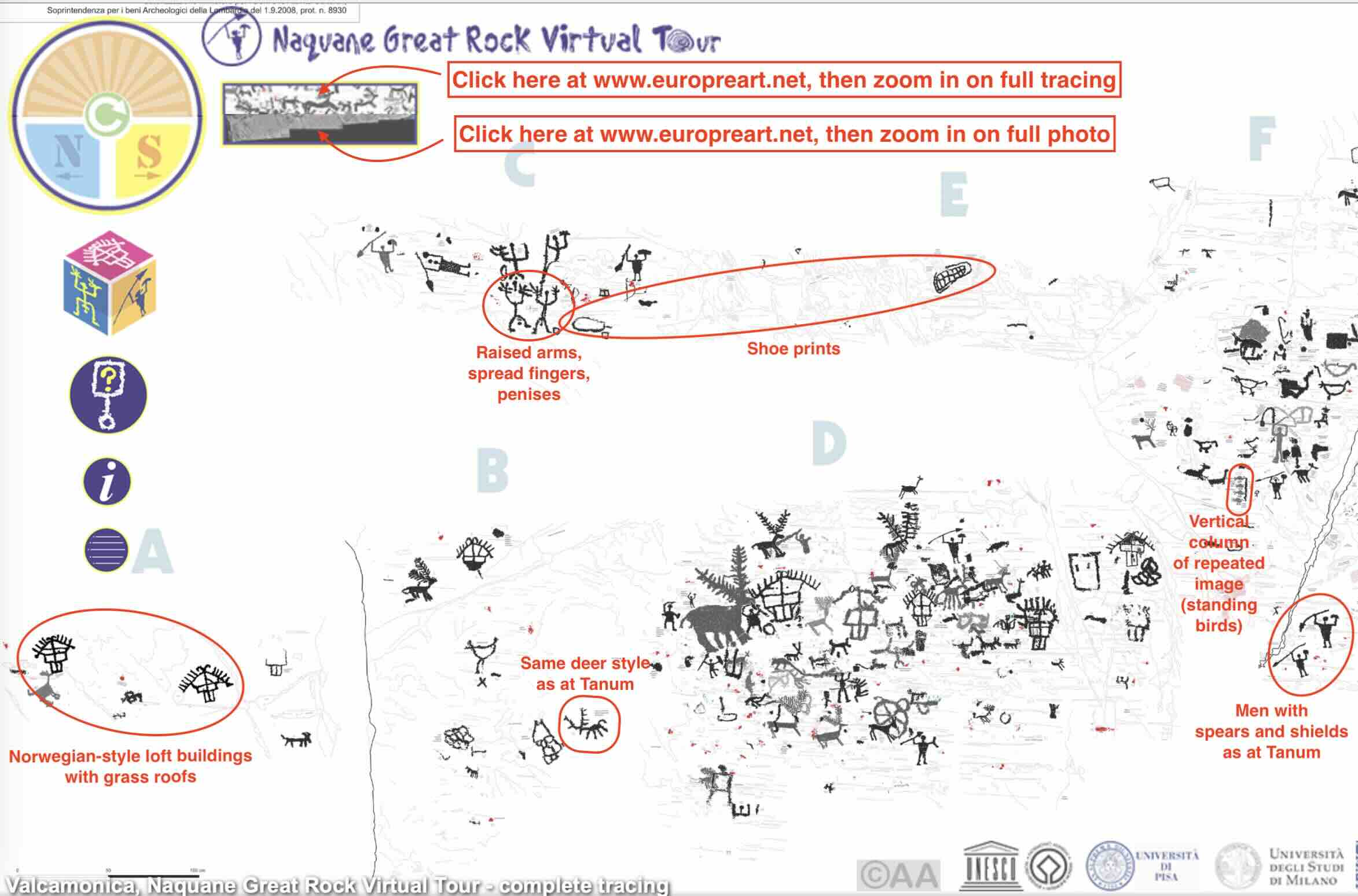
Parts A, B, C, D, E, and F of the Naquane Great Rock tracing. My notes in red.
Tryggvi Tagger. In our 'Urban Age' we are familiar with graffiti and tagging. Petroglyps were Iron Age graffiti. Stikkmann was a graffiti artist —an Iron Age 'Banksy'. Another person, whom I call Tryggvi Tagger, made cup glyps on boulders in high mountain areas of southern Norway. Tagger's engravings were not artistic, but simply showed where he had been. The photo below of Tagger's cup glyps was published by Johannes Bøe (1932) and reproduced as Fig. 156 in The Rock Art of Norway by Lødøen & Mandt (2010).
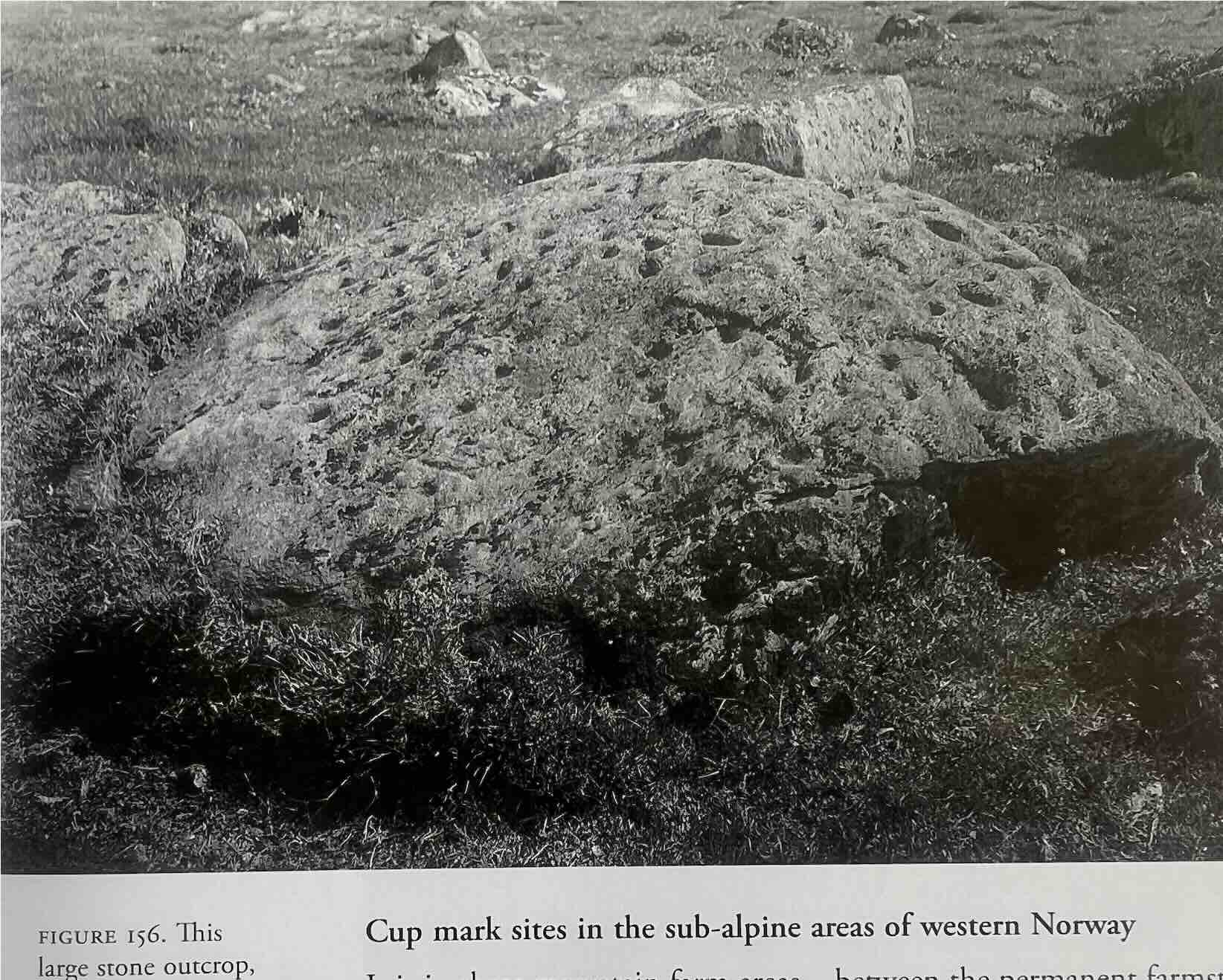
I think Tagger learned the nailpoint technique and was inspired to make cup glyps after seeing Stikkmann's work at Ullensvang on the east side of Hardangerfjord. Tagger made hundreds of cup glyps on about 50 boulders near Stikkmann'a panel at Børve. From there Tagger went north and northeast, makiong cup glyps on over a hundred boulders over a huge area, as far away as 150 km from Ullensvang. Tagger and Stikkmann made lots of cup glyps, but Innrisser, Omrisser, Vyg, and Bego never made any.
Belen Bego
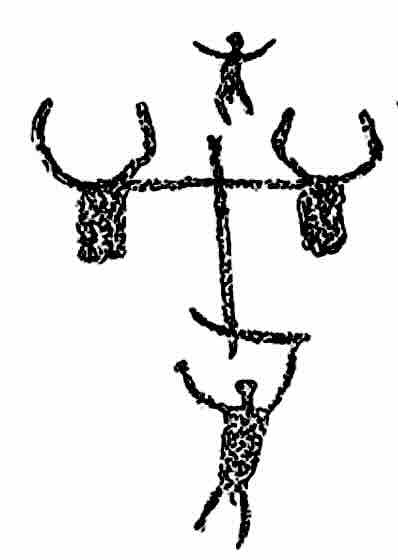
Belen Bego worked in the Valley of Marvels and Fontanalba Valley near Mont Bego in the Maritime Alps of France. He made over 14,000 glyps. Piero Barocelli, 1921 noted that the figures are made of small dots, from 1-5 mm in diameter. Bego may have learned the nailpoint engraving technique from seeing Steinn Stikkmann's art near Aussois or Turin (Torino). Stikkmann engraved a plowing scene at Aussois, and Bego made a few such scenes at Mont Bego (see the picture above, tracing by Barocelli).
See Bego's work near Mont Bego, France
Ingi Innrisser and Oddr Omrisser: Dual petroglyp artists of northern Sweden and Norway
(If your main interest is Innrisser or Omrisser, you will find the same information at Innrisser.com)
Ingi Innrisser had a childlike or primitive artistic style. He drew mostly deer —reindeer, red deer (hjort), or moose. They usually have small pointed heads, straight backs, and square rumps. He liked to decorate the bodies of deer with ribs or various patterns, including geometric designs.
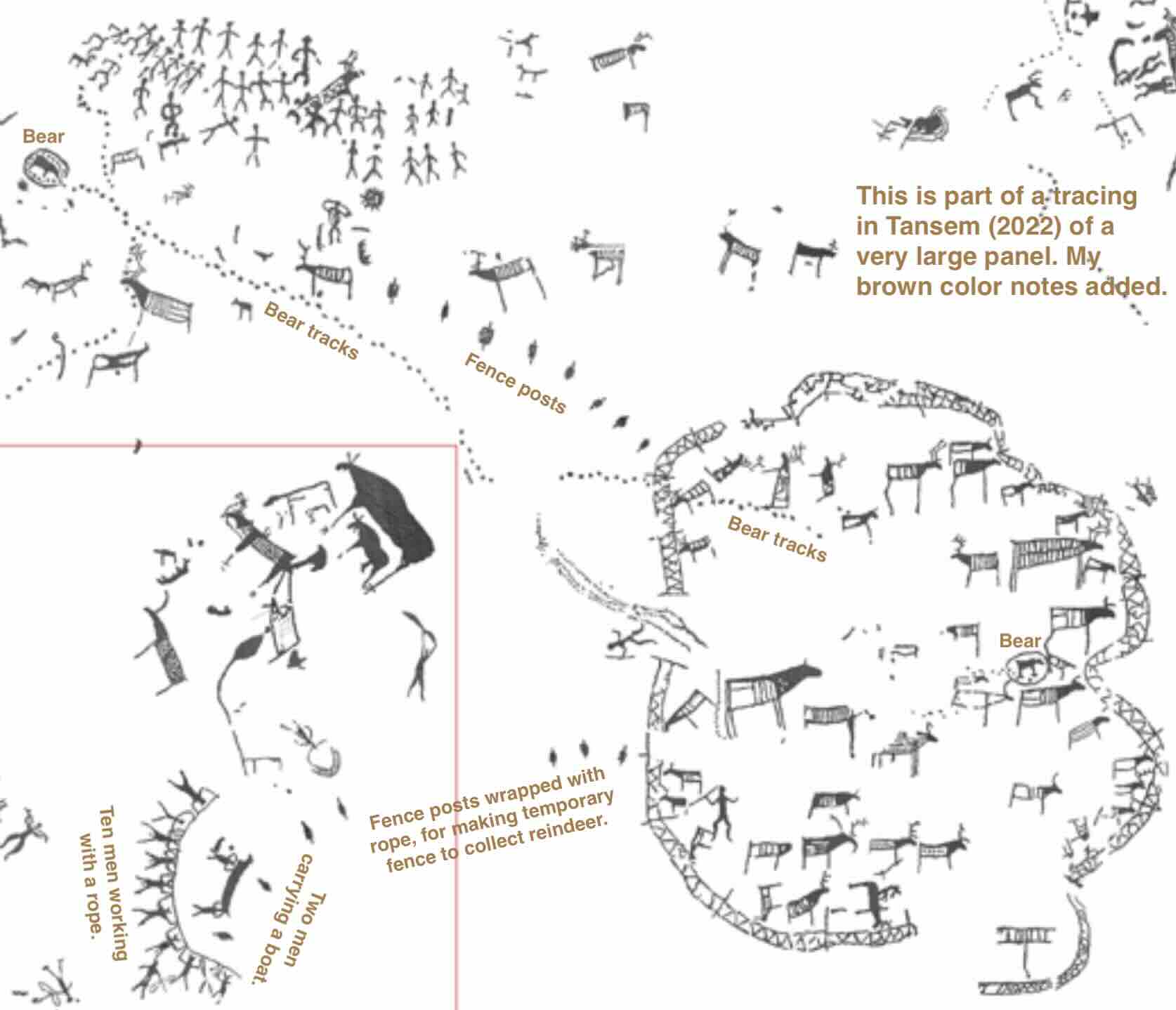
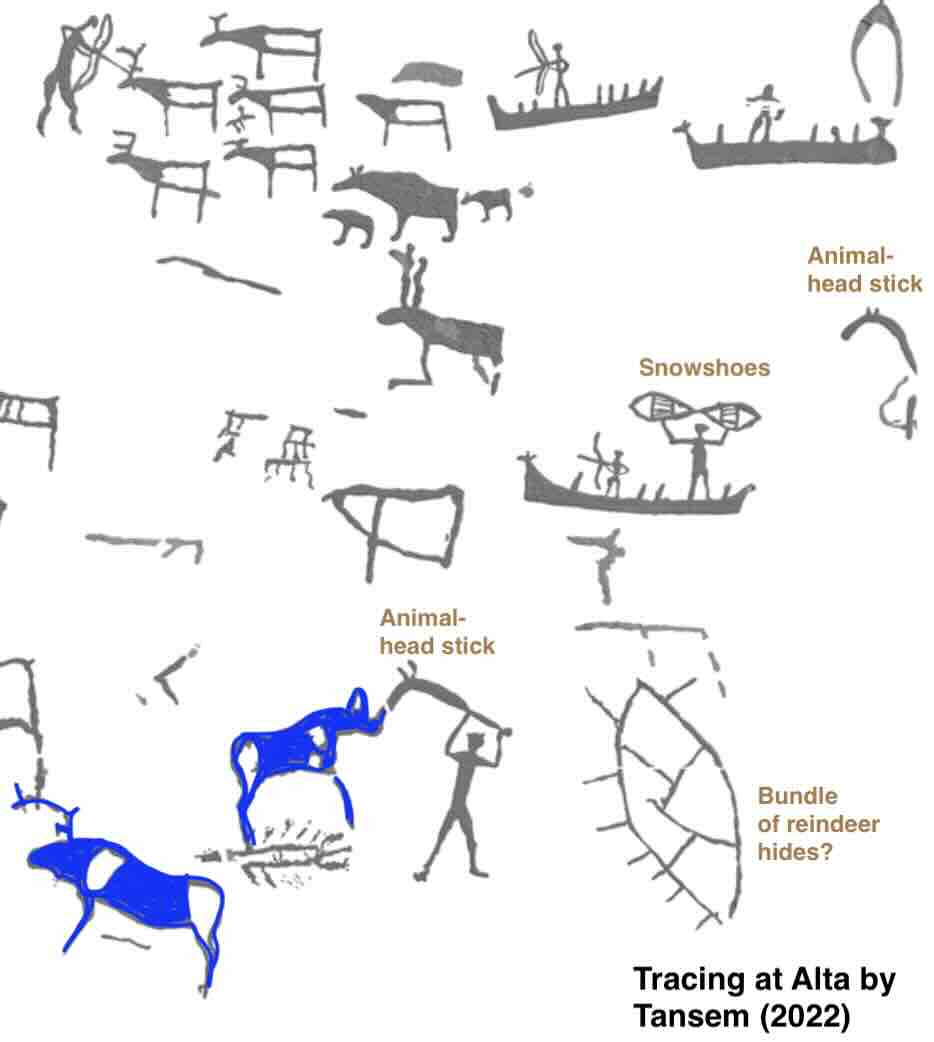
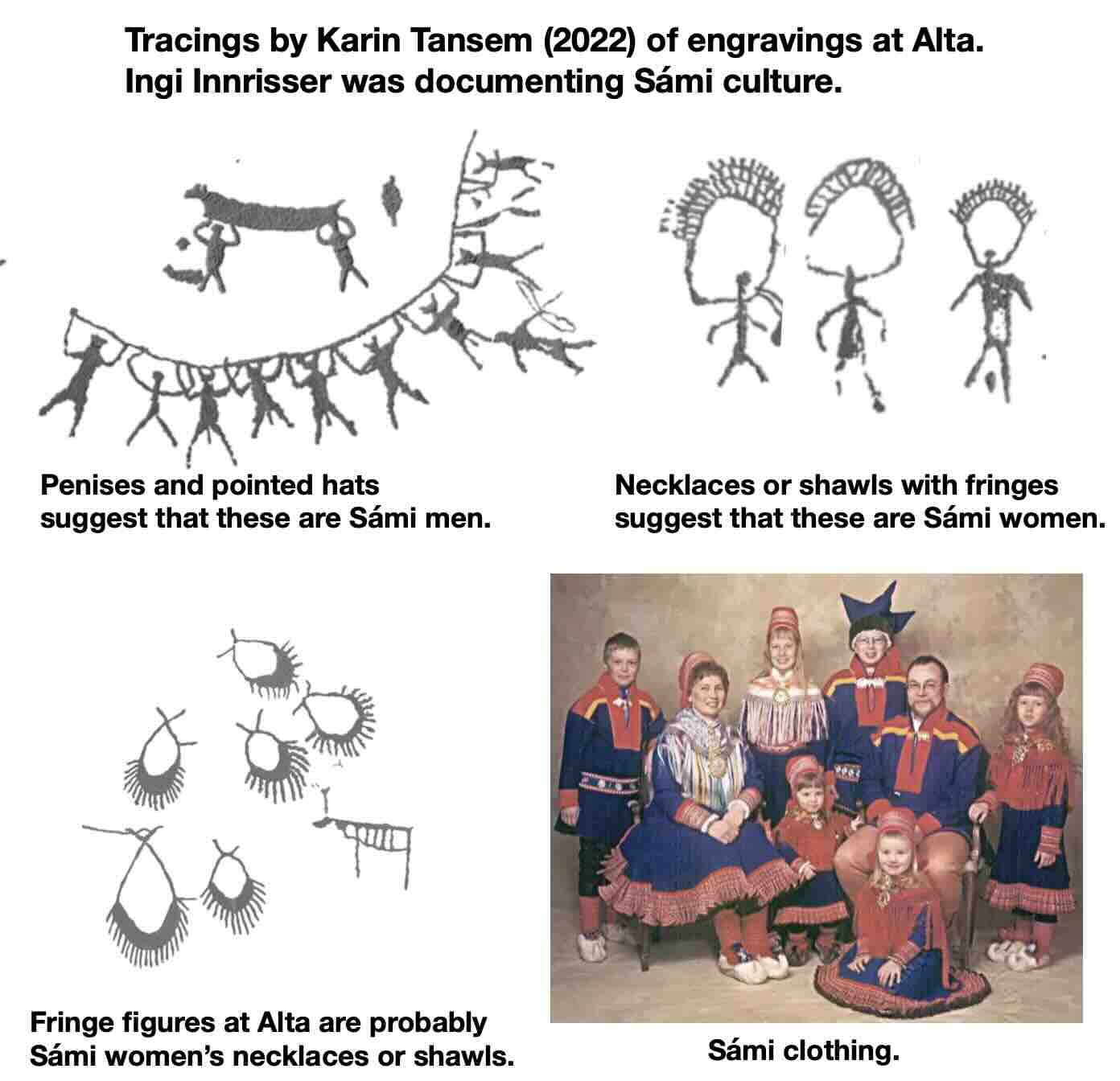
Innrisser's best work, and one of his last, was the large panel at Kåfjord near Alta. Part of that panel is shown below, in the tracing by Karin Tansem (2022). It shows a bear that has wandered into a corral of reindeer. Innrisser was documenting Sámi culture, as we know it today.
From analysis of Innrisser's motifs and styles, I am trying to follow his career. I hypothesize that his first work was at Vingen, where there are about two thousand petroglyps. I think he made them all. They include his new-beginner attempts on loose rock slabs that he could hold on his lap while engraving. The page below, from Johannes Bøe (1932), shows some of these loose practice rocks. The scale bars for the tracings are 10-30 cm. Note the curious hook figures.
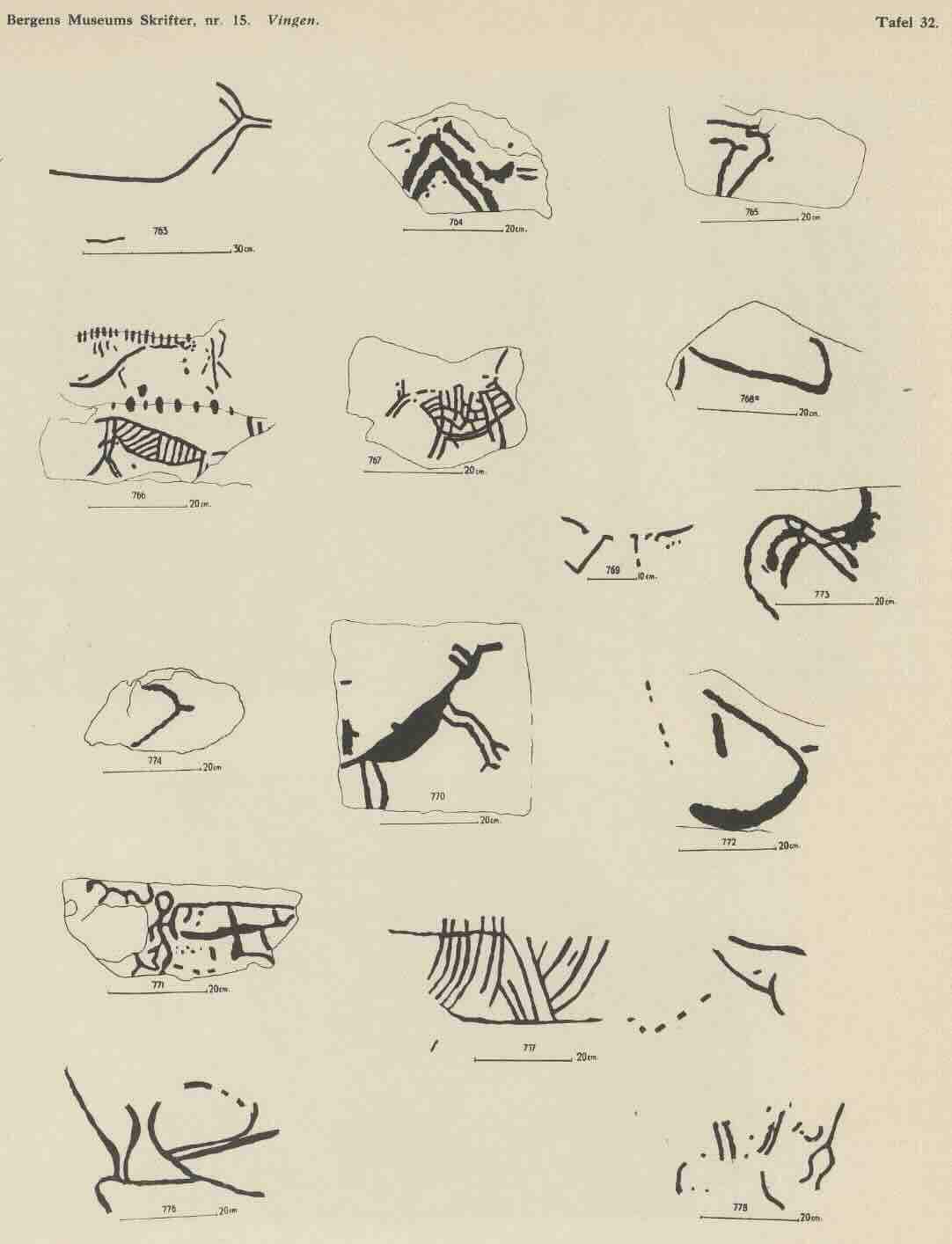
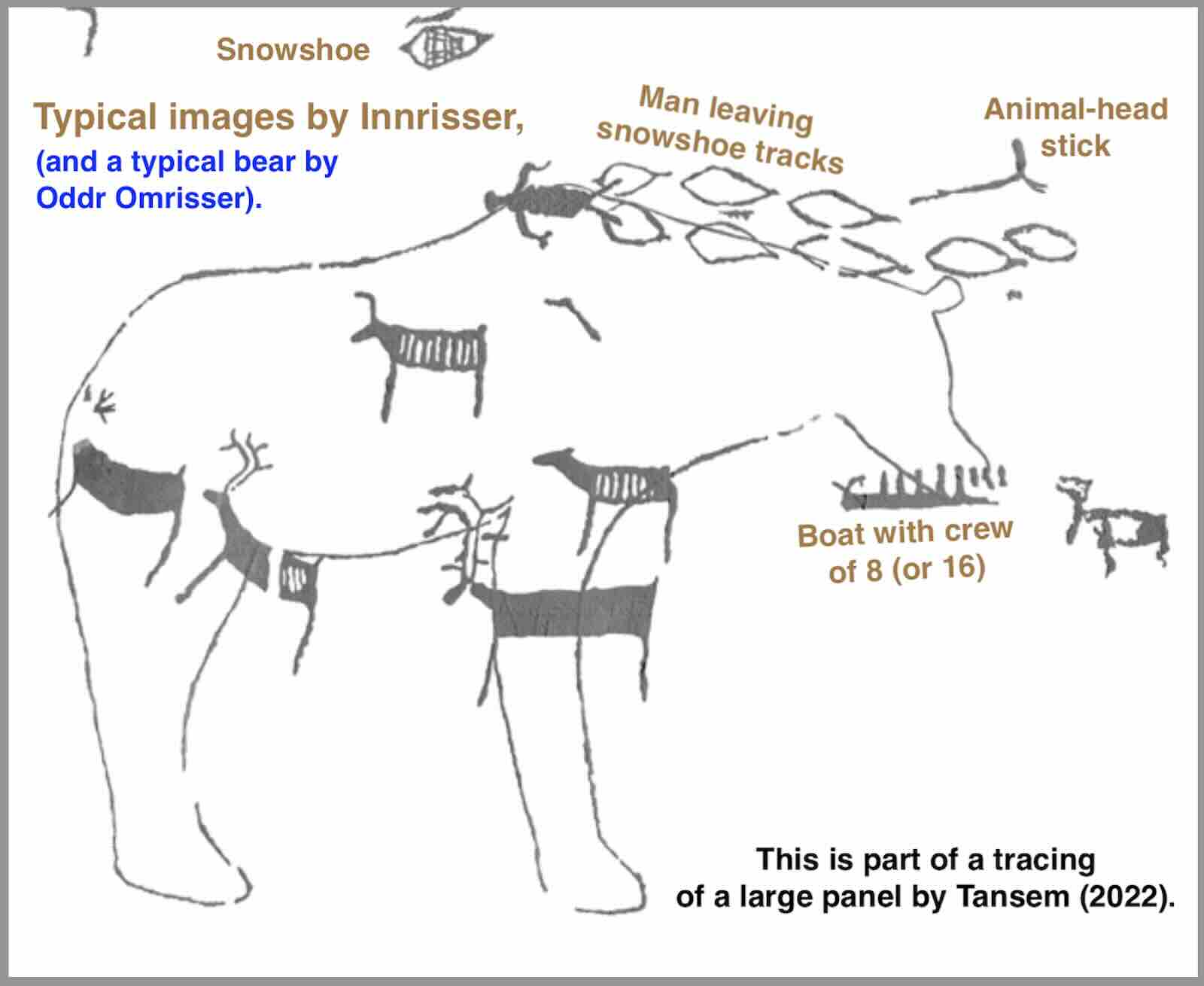
Innrisser engraved hundreds of hook figures. They comprise about 20% of his glyps at Vingen. I think he made the hook figures mostly to practice nailpoint engraving. He also made a few hook figures at Nämforsen. He made many at Alta (Hjemmeluft, Kåfjord, and Langnesholmen) such as in the Kåfjord figure below. At those sites we can see that the hook figures are animal-head sticks, often being held up high by men. A few at Nämforsen are also held by men. Knowing that, we can notice that many of the hook figures at Vingen have animal ears (see Bøe's images in the page above.) Maybe Innrisser was depicting an animal-head walking stick that his father or grandfather had used.
Vingen is an isolated place, and there have never been more than a few houses there. I suspect that Innrisser actually lived in the Skatestraumen area, which was a population center in pre-Viking ages. It is about ten kilometers by rowboat from Vingen. Two-way tidal currents make the boat trip easy at certain times each day. Innrisser probably learned about nailpoint engravings from seeing Stikkmann's work. Then he probably visited Vingen daily for many weeks, making his own petroglyps there.
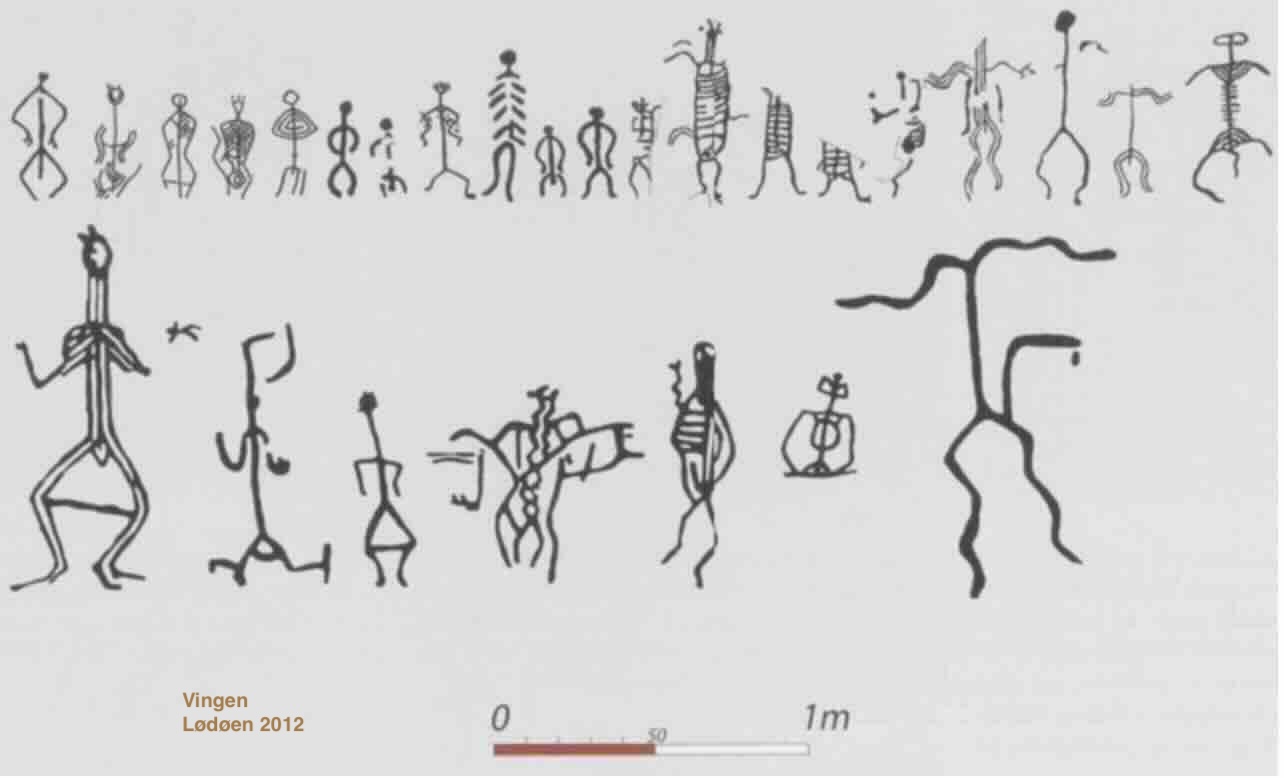
Innrisser took a long trip to northern Norway. I think he showed Oddr Omrisser how to engrave rocks at Tennes and Alta (Storsteinen and Amtmannsnes) during that trip. His next major work was probably at Ausevik near Vingen. His human figures at Vingen, Alta, and Ausevik are all wildly abstract. So are many of his deer at those places. He was experimenting with creative ways of drawing. In the picture below, Trond Lødøen (2012)) has put together 27 of the 61 humans at Vingen. No two human images are alike.
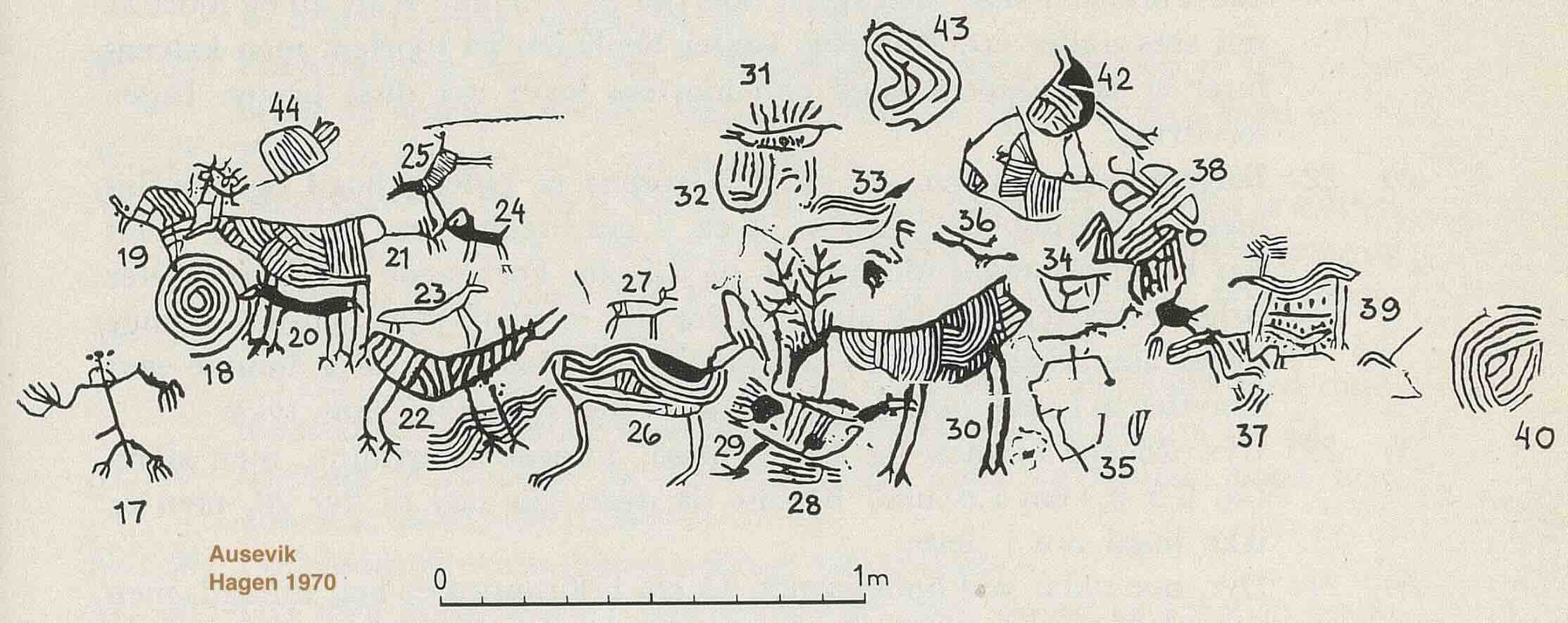
The tracing below by Anders Hagen (1970) of a panel at Ausevik shows one abstract human and about 13 deer. Innrisser also drew these images during his early experimental phase.
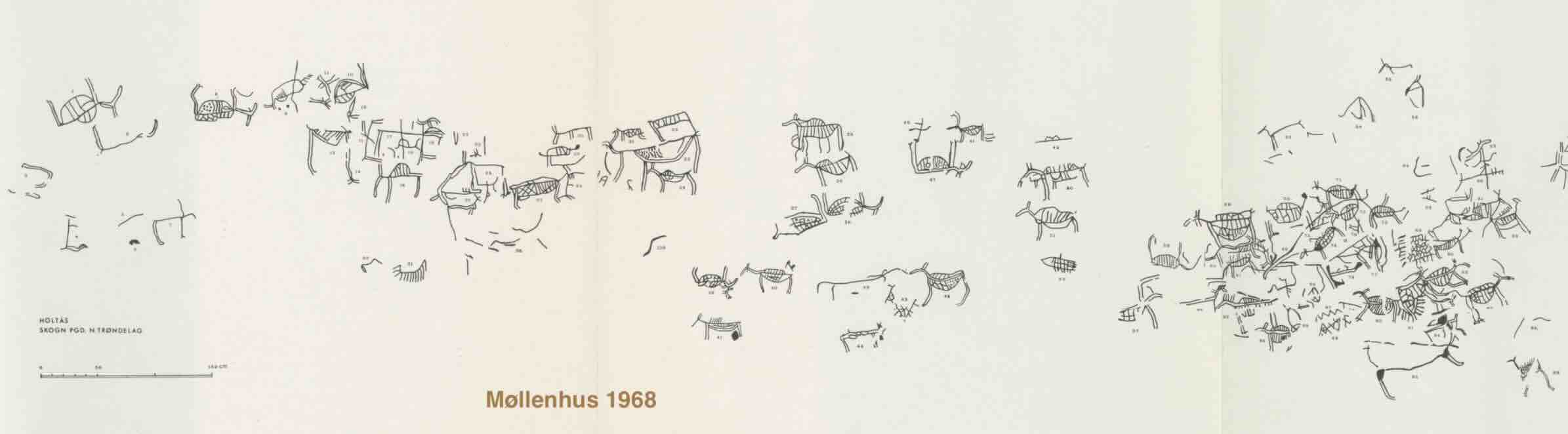
At most of Innrisser's sites (but not Vingen or Ausevik) he was together with Oddr Omrisser. Omrisser was a naturalist, and encouraged Innrisser to make his deer more anatomically correct —with shoulder humps, muscular legs, and larger heads. At Holtås in Trøndelag, I think Innrisser mocked Omrisser by adding silly-looking shoulder humps to the straight backs of his deer. See the tracing by Kristen Møllenhus (1968) below.
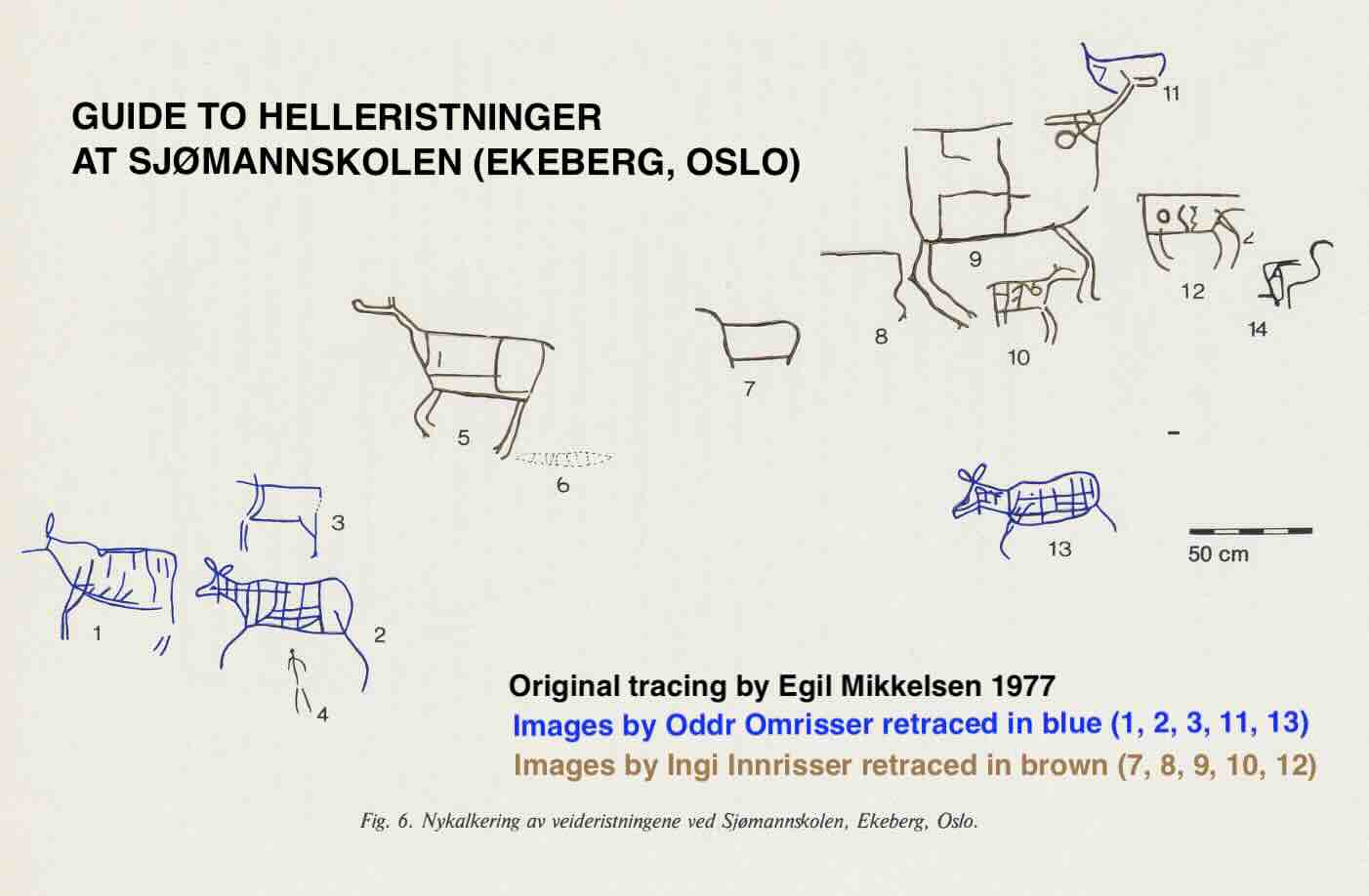
Innrisser and Omrisser took a long trip to eastern Norway (Oslo and Drammen), probably following one river valley south, and another back north. Innrisser added shoulder humps to his deer at some of those sites, such as at Skogerveien. See the tracing below by Egil Mikkelsen (1977).
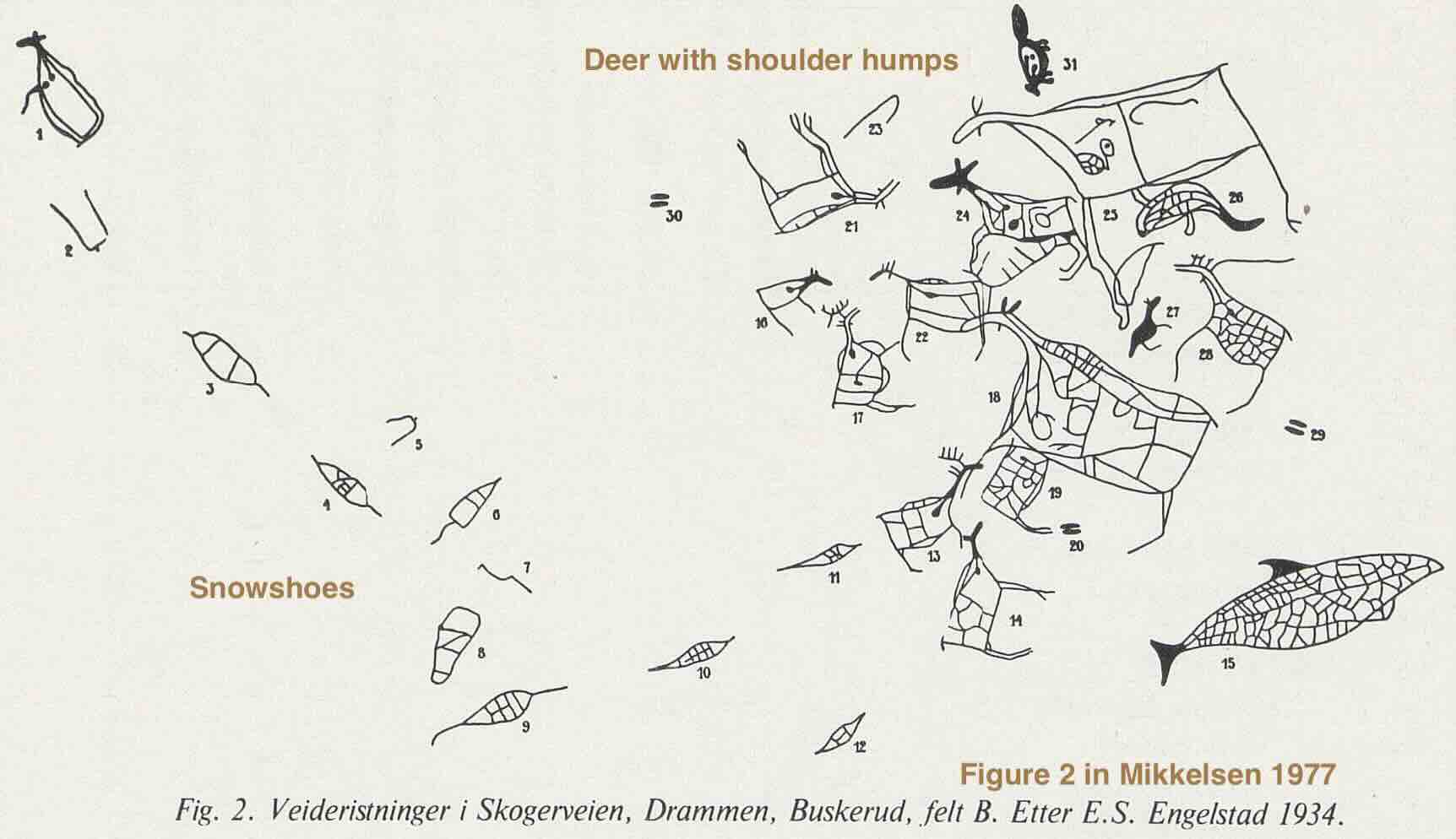
Recognition of an artist's interests helps us to interpret obscure images. Innrisser liked snowshoes, and drew snowshoes or snowshoe tracks on many panels at Alta. So in the tracing at Skogerveien (above), the strange objects on the left are probably snowshoe tracks.
Snowshoes in Alta do not necessarily depict winter scenes. Snowshoes can also be helpful in Alta in the spring, when there is 24-hour daylight, and when Innrisser's longship probably arrived. In the tracing below, I think the man standing in the animal-head boat is holding up a pair of snowshoes. (Innrisser showed the snowshoes held up high, so they would be noticed.) The objects below the boat may be an animal-head stick, and a bundle of reindeer skins to be taken by longship to southern Norway. I have colored two reindeer blue, because they were added by Omrisser, and not really part of Innrisser's panel.
Innrisser's panels at Kåfjord and Bergbukten (Alta) are especially important, because they are some of the earliest documentation of Sámi culture. He showed reindeer in corrals, and Sámi clothing items. The traditional clothing of Sámi men in the Alta area includes a hat with points. The traditional clothing of Sámi women includes a shawl with fringes. (Innrisser showed the boat, rope, and shawls up in the air to be easily seen.)
I currently think that Innrisser worked his sites in about this order (see site locations on the top map): Vingen, Amtmannsnes (Alta), Storsteinen (Alta), Tennes, Skavberget, Ausevik, Surnadal, Salthammer, Bogge, Glösa, Holtås, Bardal, Eidefossen, Dokkfløyvatn, Drotten, Møllerstufossen, Stein, Glemmestad, Ekeberg, Skogerveien, Åskollen, Geithus, Nämforsen, Langnesholmen, Gåshopen, Slettnes, Leirbukt, Gamnes, Apana Gård (Alta), Ole Pedersen (Alta), Bergheim (Alta), Bergbukten (Alta), Kåfjord.
Oddr Omrisser usually made outlines of his objects —of animals, of boats, of people, and even of the antlers of reindeer and the penises of men. He made images large and even life size when possible. He was a naturalist, and many of his animals are very lifelike. The species of his deer, birds, fish, and whales can often be identified.
He had his quirks. He liked to draw a line for the mouth, but no eye. He often ignored the feet, leaving the legs unfinished or ending as points. He usually drew animals in profile, but not the ears, which often form a V. He showed only one foreleg and one hind leg on four-legged animals. (Innrisser and Stikkmann usually drew four legs.) He sometimes indicated a 'life-line' from the mouth to the stomach or heart. Innrisser did this also at some of his sites.
Omrisser's images are typically overlapping and incomplete. I think he drew the complete animal, maybe with charcoal, and then engraved it only partially. We can deduce that from seeing incomplete images such as the 6-meter long whale in the tracing below. He had the habit of cluttering rock panels by drawing large and inappropriate images right on top of earlier carvings. He cluttered most of his own panels in that way, and defaced Stikkmann's panels at Bardal, Hammer IX, Revlan, and Stavanger, and Innrisser's panels at Alta, Bogge I, Ekeberg, Kåfjord, Langnesholmen, and Nämforsen.
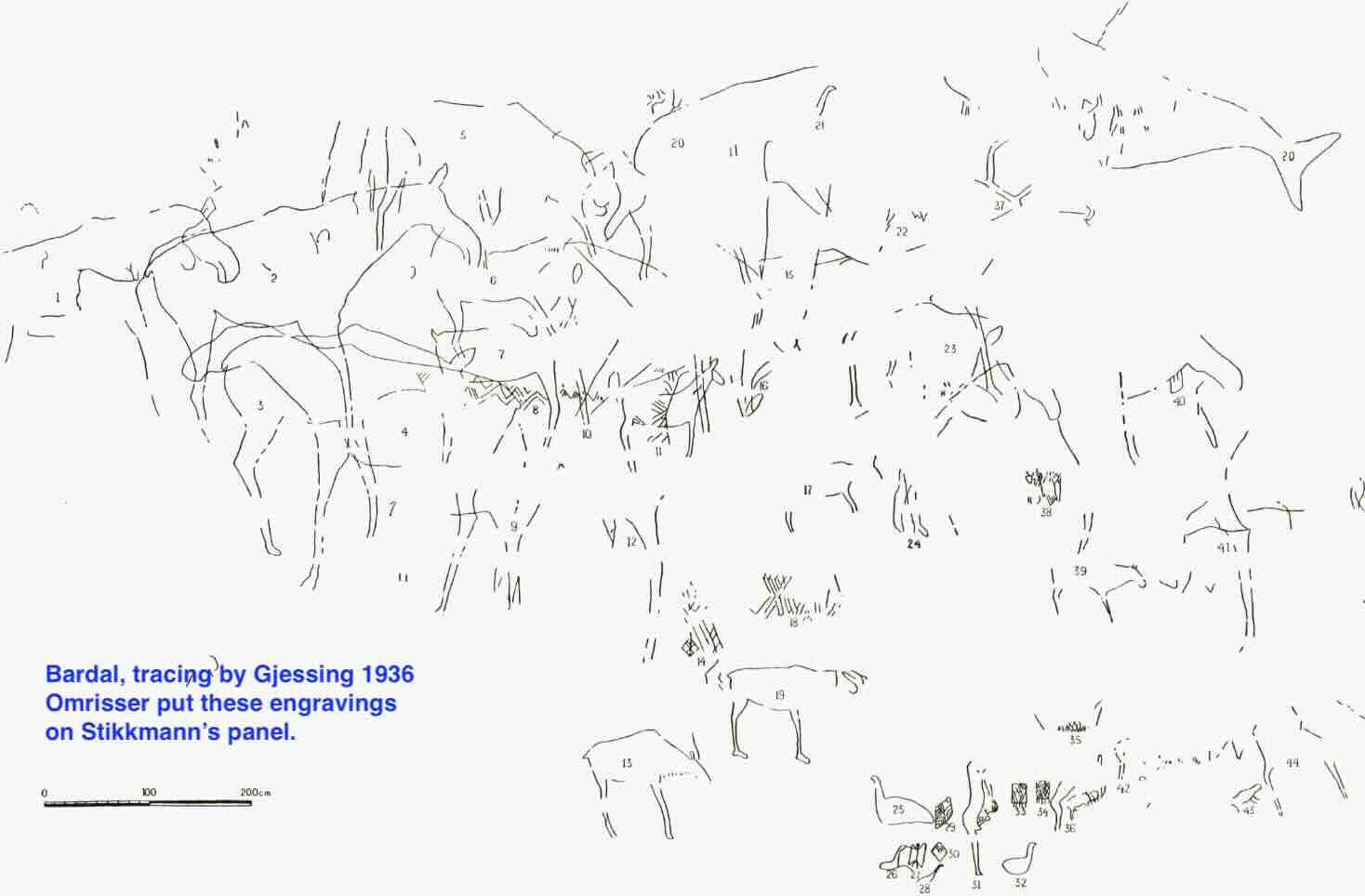
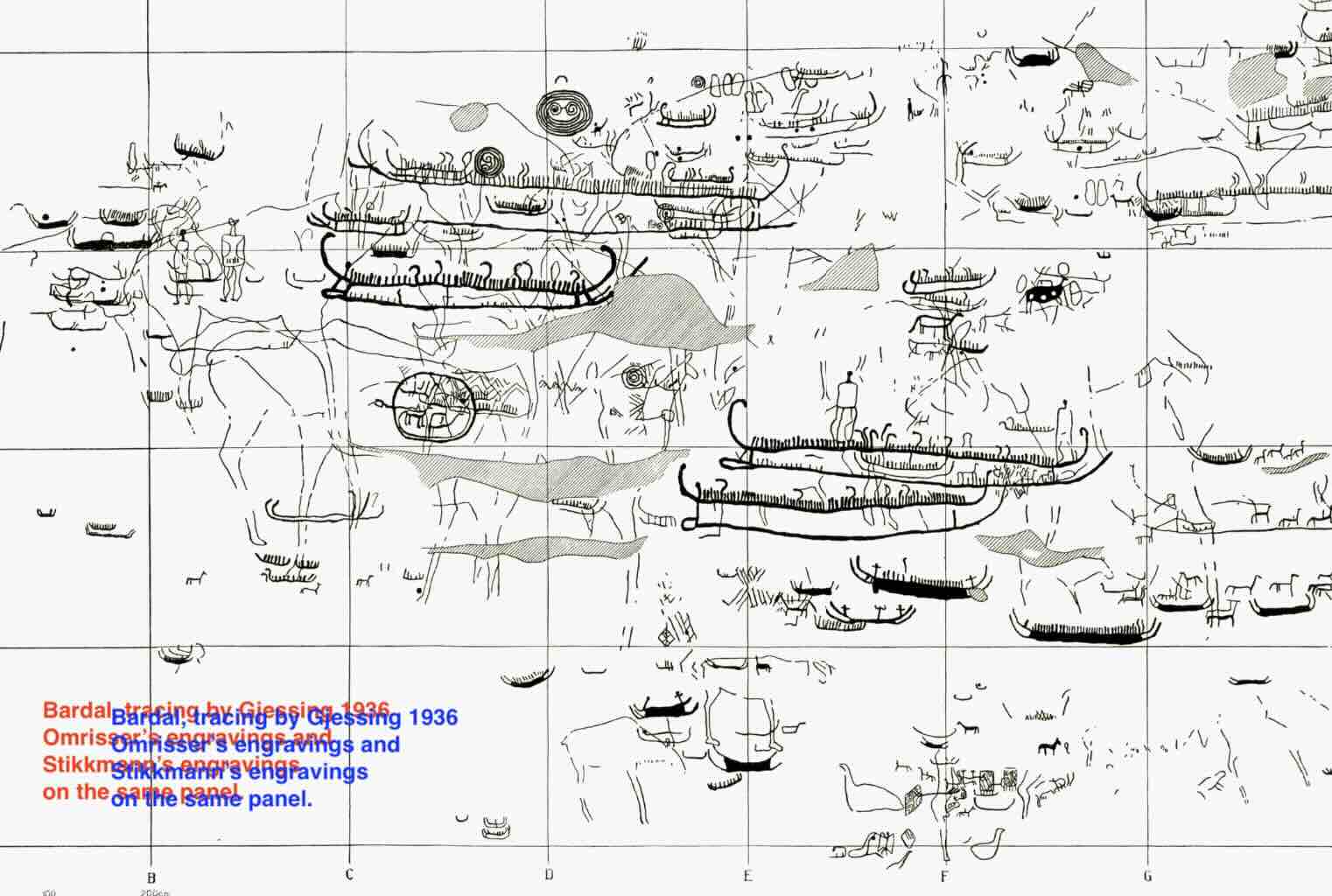
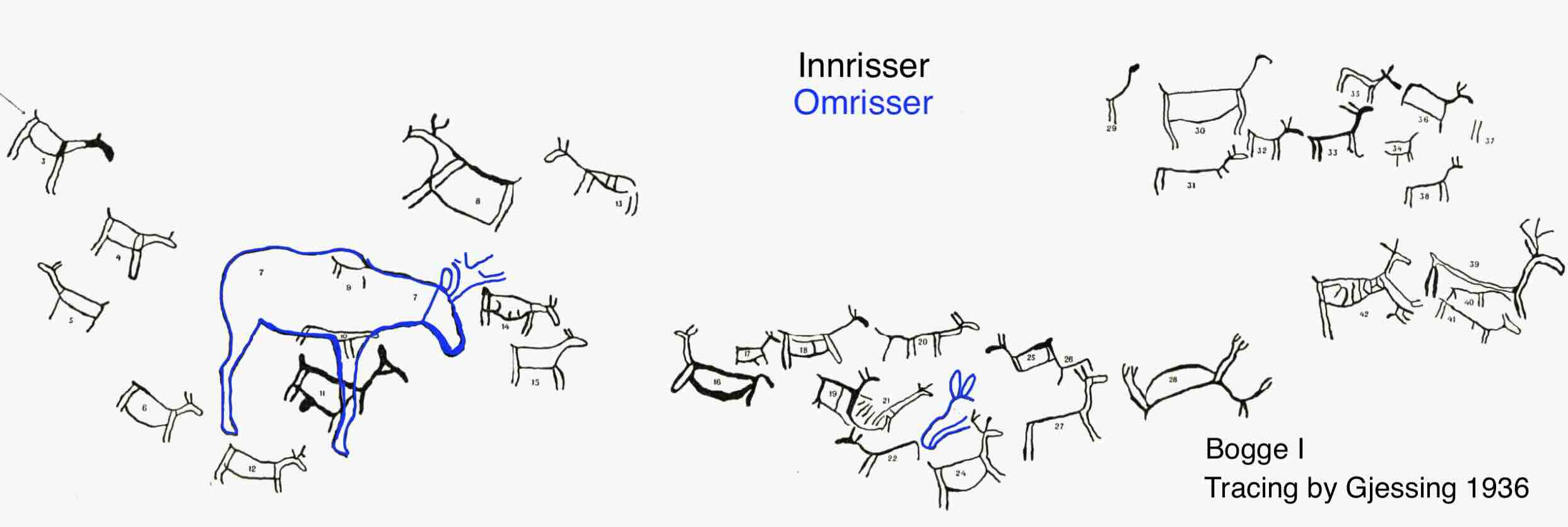
At Bogge I, Innrisser drew many deer, and then Omrisser put an oversize moose on top of some. He added a large deer-head there as well. Below is part of the tracing by Gutorm Gjessing (1936) of the defaced panel, where I have colored Omrisser's two images blue. I think Innrisser told Omrisser to get away and find another place to work. So Omrisser went down the hill and made two panels of his own (Bogge II, Bogge III). The same thing happened at Holtås I and II.
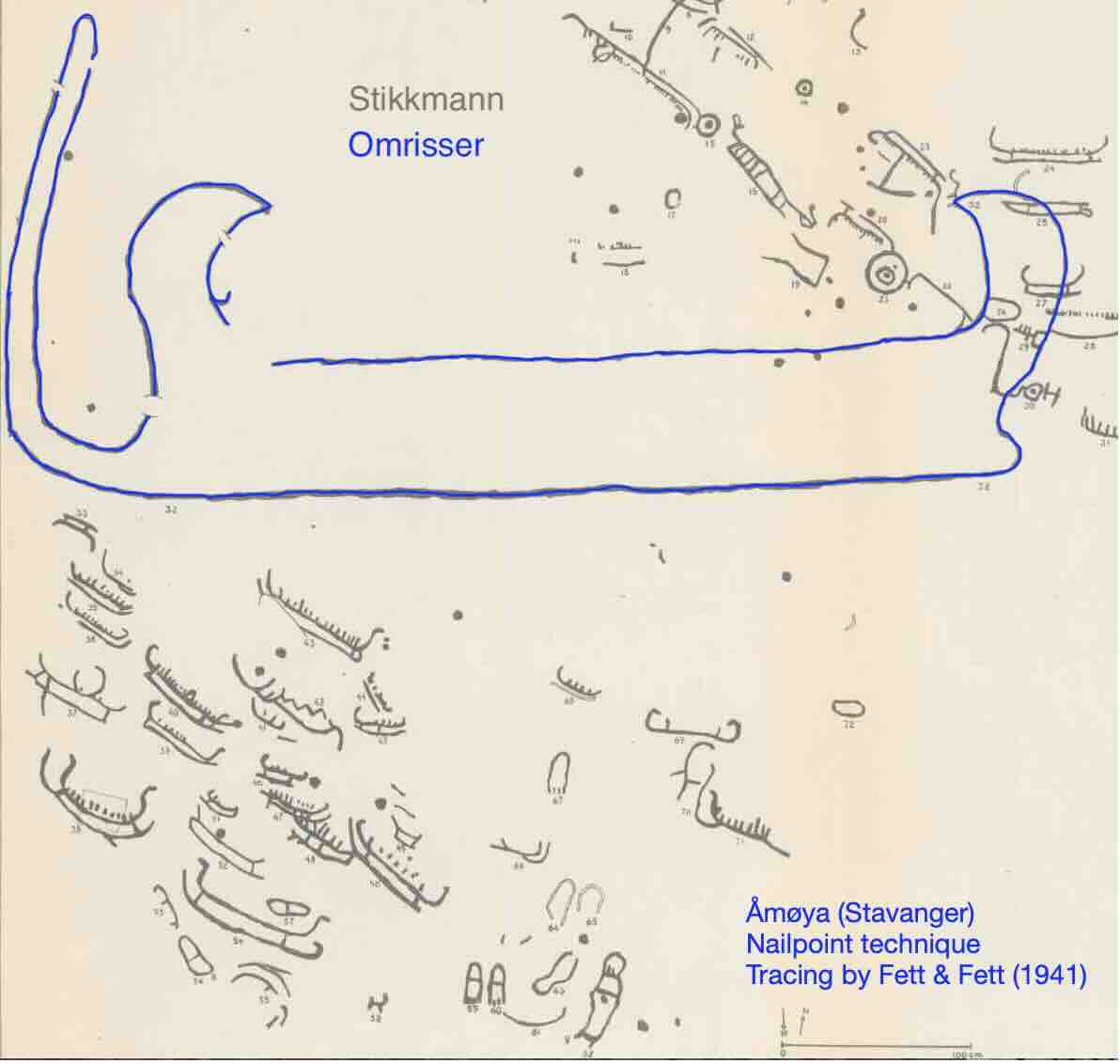
Below on the left is a tracing by Eva & Per Fett (1941) of a panel at Stavanger (Åmøya). It shows typical boats and shoe prints by Stikkmann. Omrisser defaced the panel by putting a few images (which I have changed to blue) on top of Stikkmann's images. Omrisser was copying Stikkmann's boats, to learn how to draw outlines of that boat type. He then made a 5.5 meter boat nearby. On the right is a tracing by Tansem (2022) of a panel at Kåfjord by Innrisser. Omrisser defaced the panel by putting several images on top of Innrisser's images. Note that Omrisser drew the same fish at Stavanger and Kåfjord, and the deer-head at Kåfjord is the same as at Bogge. He made that distinctive deer-head (often without the body of the deer) at many places in Norway and Sweden.
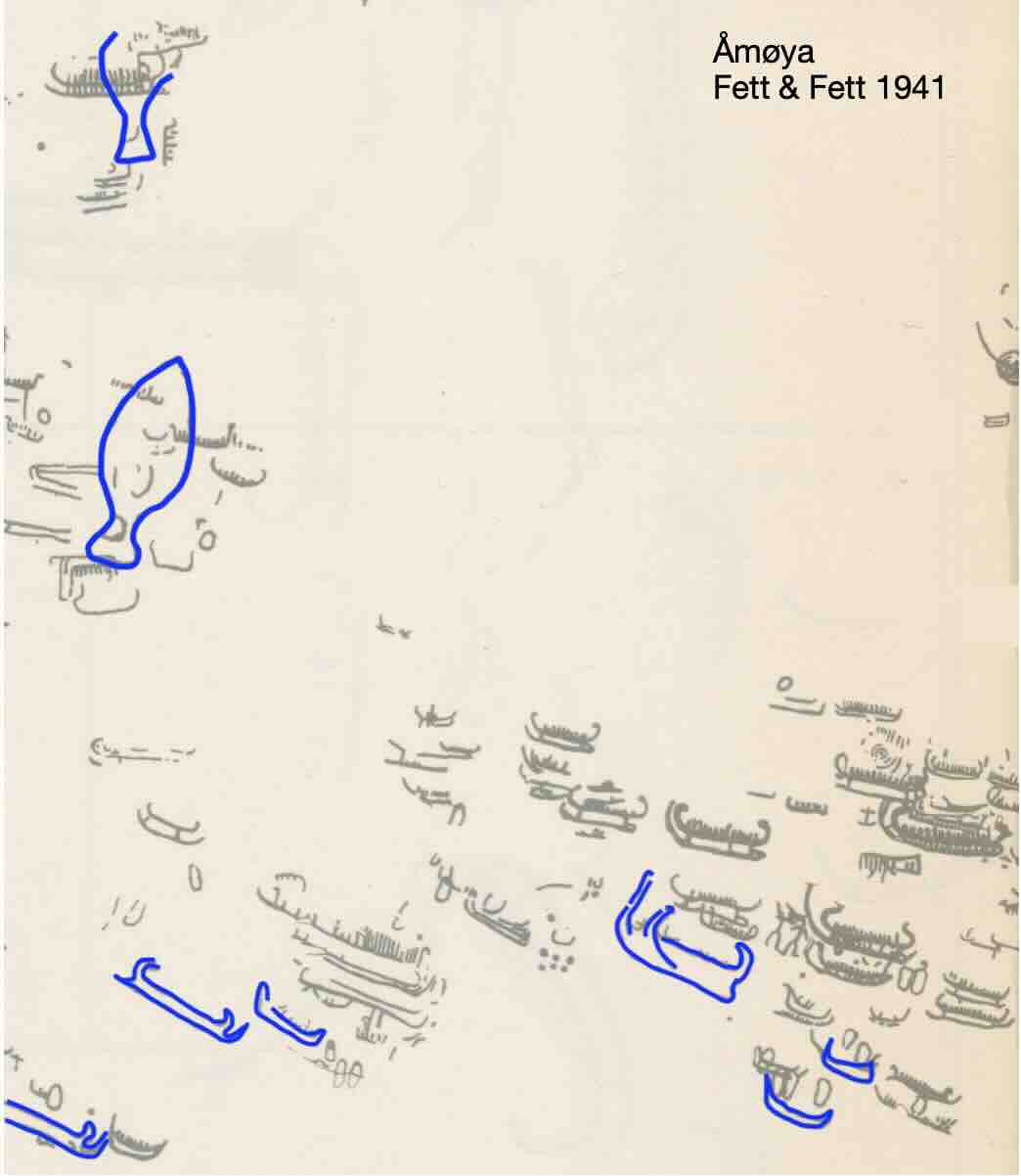
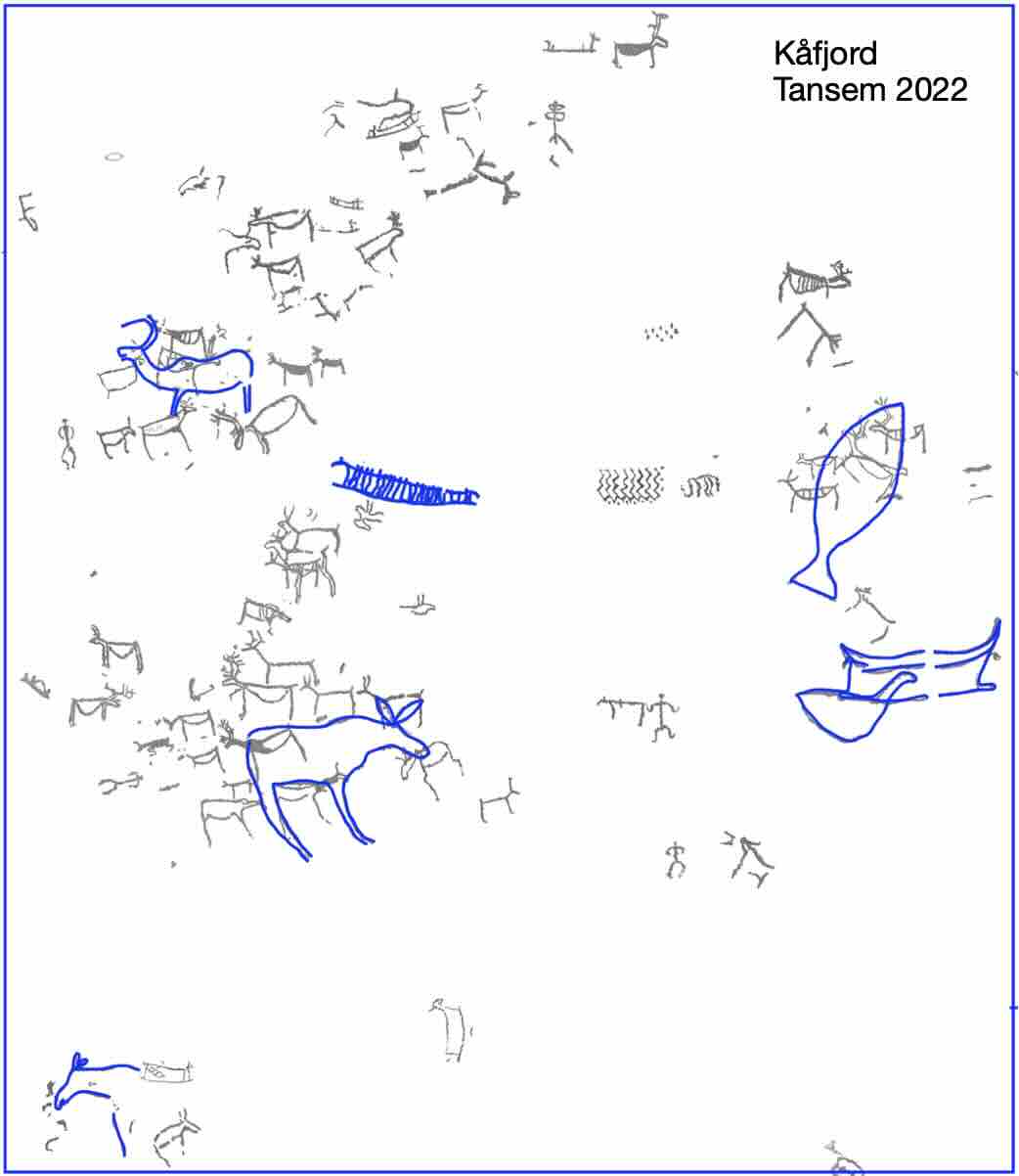
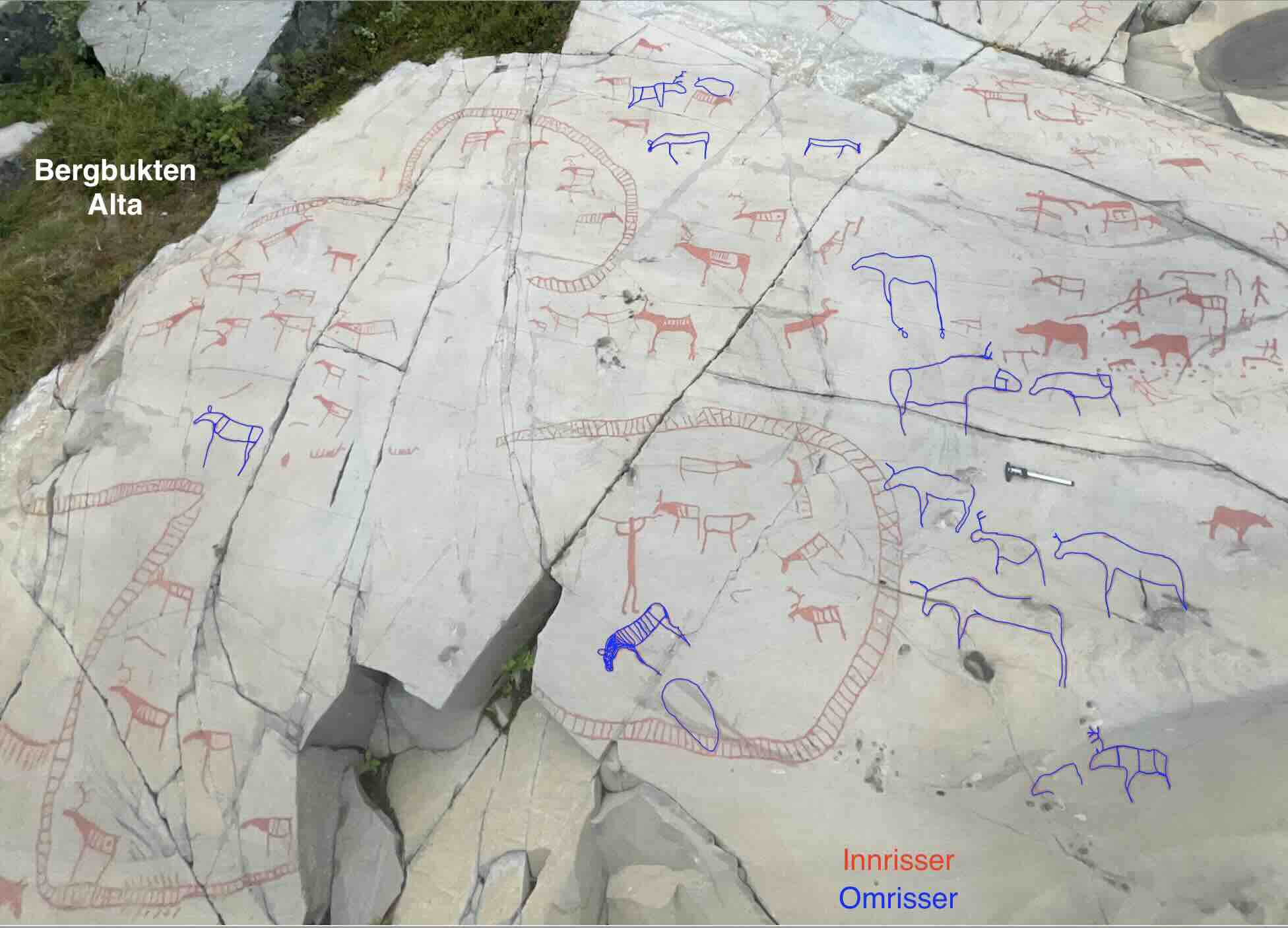
Some of Omrisser's added images almost fit in. At Bergbukten (Alta), Omrisser added reindeer (slightly oversized) to Innrisser's panel of reindeer and a corral. (Note also Innrisser's three bears making tracks as they head toward the corral.) All the images were painted red by Alta Museum, but I have changed Omrisser's images to blue in my photo (August 2025).
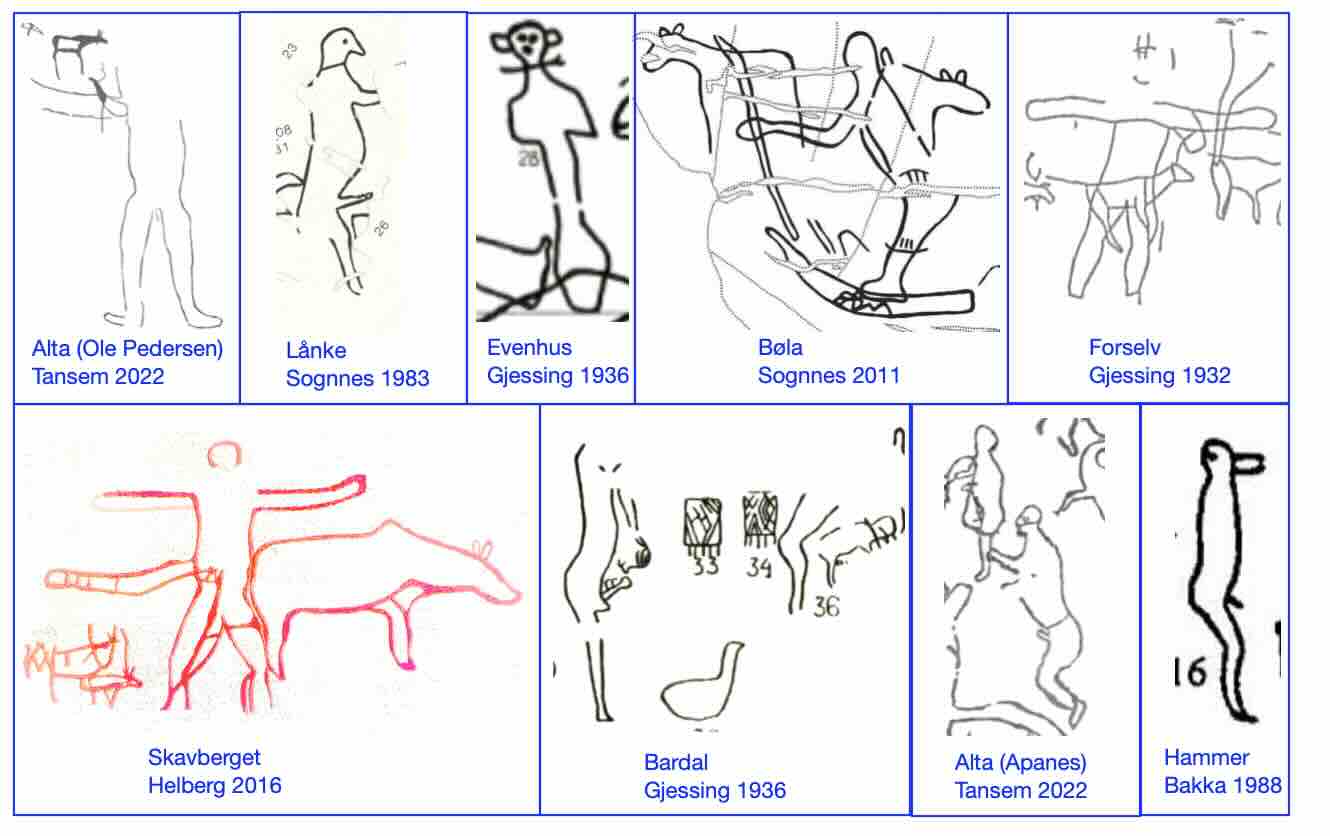
Omrisser usually made humans as small stick figures, like many of Innrisser's. But some of his humans are large and outlined, like his animals. Below is a collection of Omrisser's outlined humans. His men in profile, at Lånke, Bardal, Alta, and Hammer, have long torsos and undersized legs. In his sex scenes at Bardal and Alta the female has the size and proportions of a child. These are interesting quirks of Omrisser.
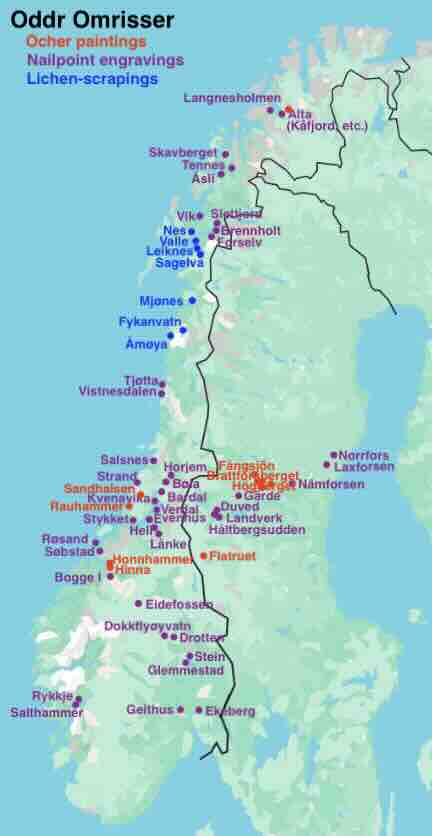
Early in his career, Omrisser painted rock panels at dozens of sites in northern Sweden. He painted with red ocher pigment, probably mixed with fat that penetrates the rock surface, leaving red traces that are still visible after more than a thousand years. (If there are oil stains on your kitchen's granite countertop, they may also last a thousand years :-) He must have worked during the winter or spring in Sweden, when he could stand on ice-covered lakes and paint rock panels at the lake edge. Later, he also stood on frozen lakes to make engravings. I suspect that he was born south of Strömsund Sweden, where there is a cluster of rock paintings, all within skiing distance from each other. They are not far from Nämforsen, where he and Innrisser worked together making nailpoint petroglyps. Their engravings at Nämforsen are quite similar and difficult to distinguish.
Omrisser's earliest engravings may have been the crude ones at Tennes. We see this most clearly in the porpoises, a motif that he liked to draw. Some of his porpoises are shown below. Note the porpoises' tails typically point down. Also note that he used two short lines to indicate flippers on porpoises at Tjøtta, Salsnes, Hammer, Tennes, and Amtmannsnes (Alta). Such quirks suggest the work of a single artist.
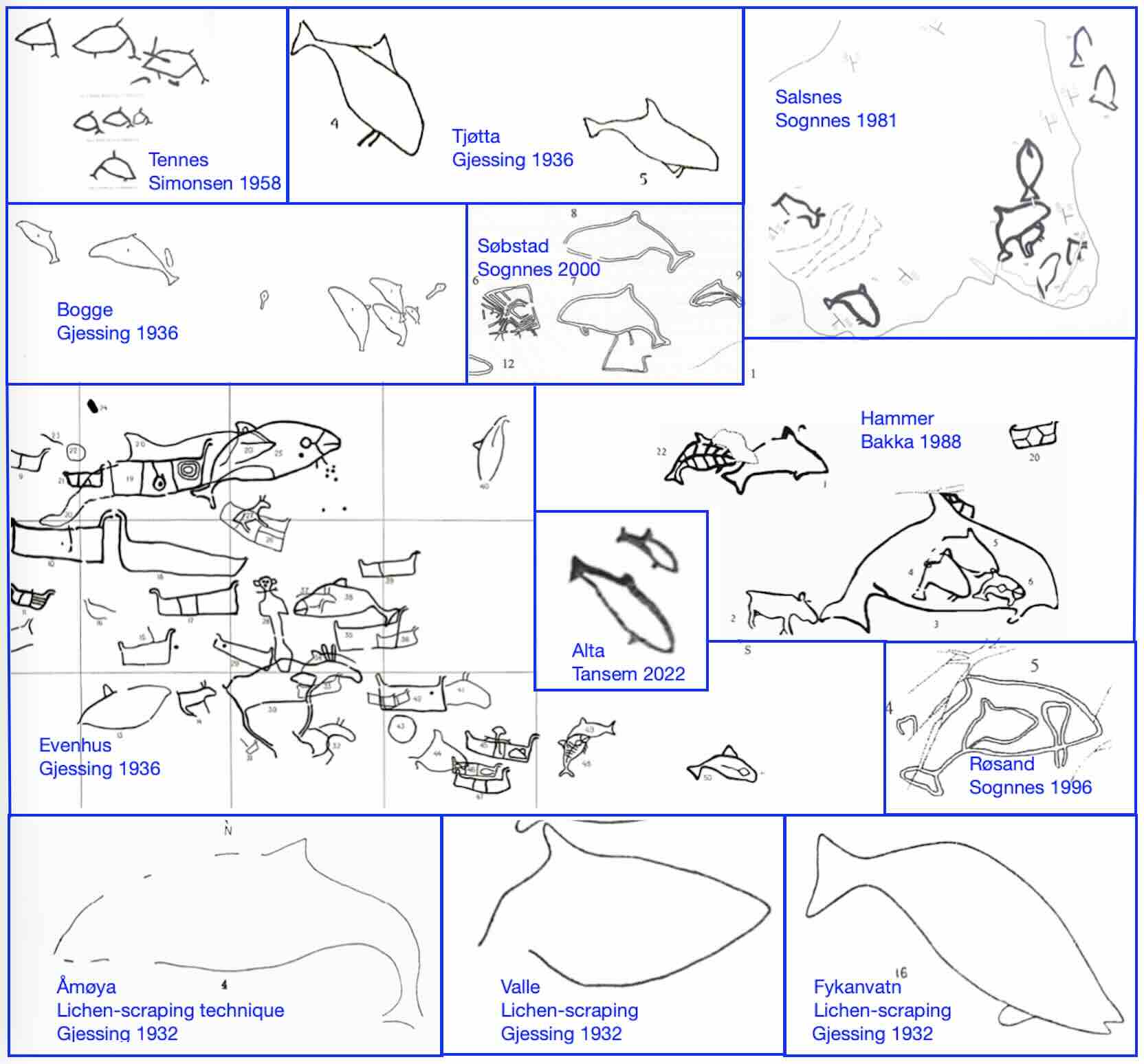
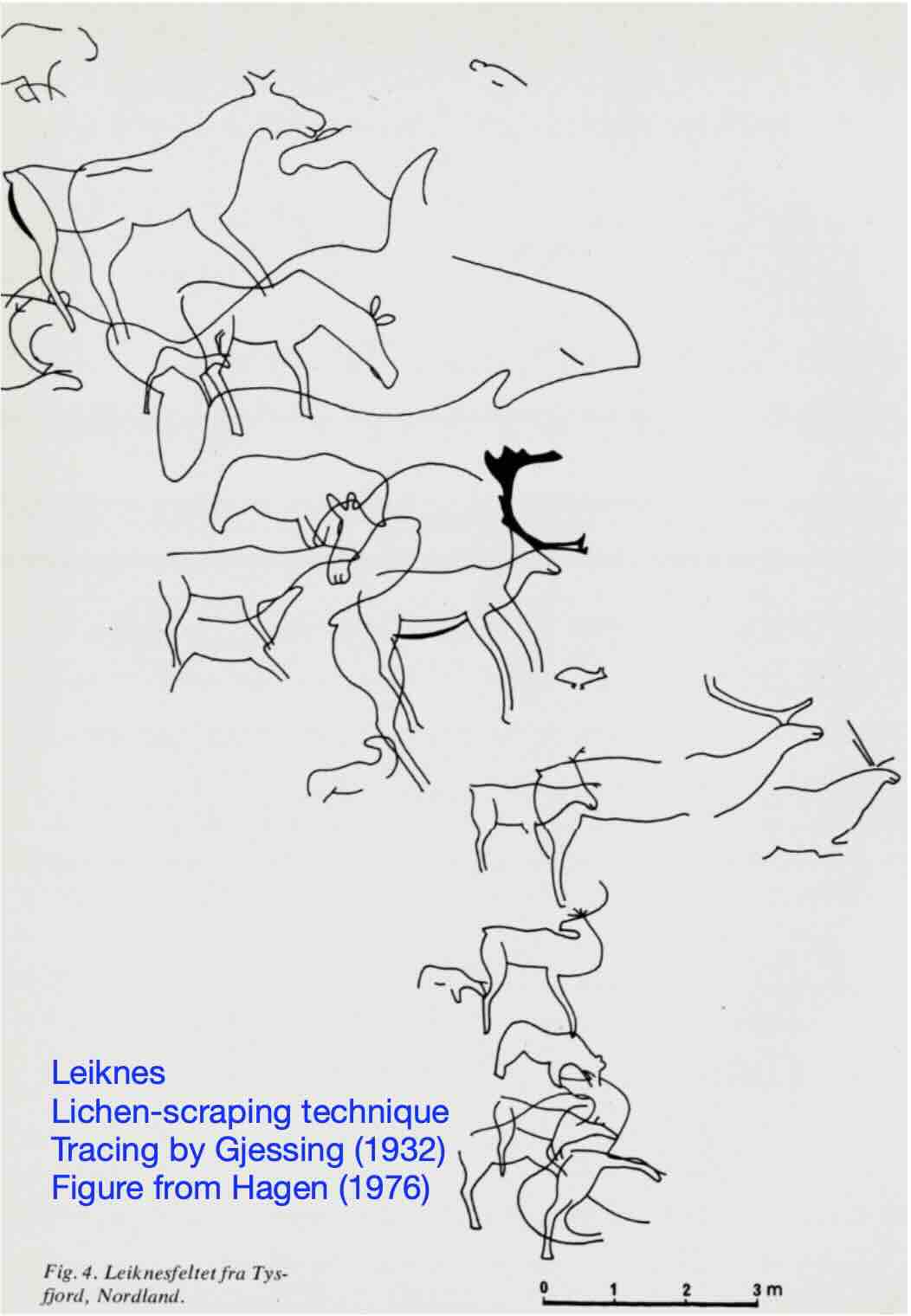
Omrisser used four different techniques during his career. He started with red ocher painting in Sweden. Afterward, he mainly used the nailpoint technique, but made a few red ocher paintings in Norway that included some nailpoint engraving: at Sandhalsan, Honnhammerneset, Hinna, and maybe at Transfarelv in Alta. He also tried incising petroglyph figures with the point of a knife, at Gärde and Hell. Late in his career, at the peak of his anatomical drawing skill, he discovered that he could quickly and easily make large petroglyphs using the abrasion technique. He scraped away black lichen that covers the surfaces of glacially-polished white granites. He made life-sized and lifelike images of animals at seven known sites in Nordland: Leiknes, Fykanvatn, Mjønes, Nes, Sagelva, Valle, and Åmøya.
Omrisser made Scandinavia's largest petroglyphs and petroglyps. His outlined orca whale at Leiknes (petroglyph, below left) is 7.5 meters long, and his outlined boat at Åmøya on one of Stikkmann's panels (petroglyp, below right) is 5.5 meters long.
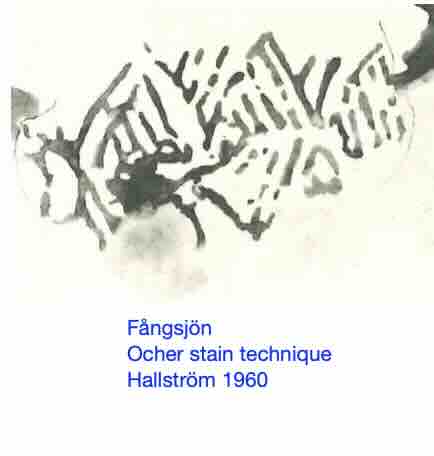
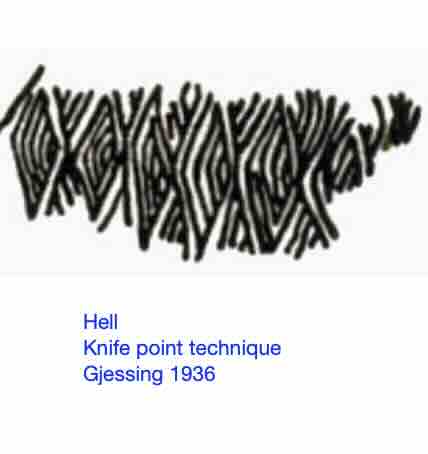
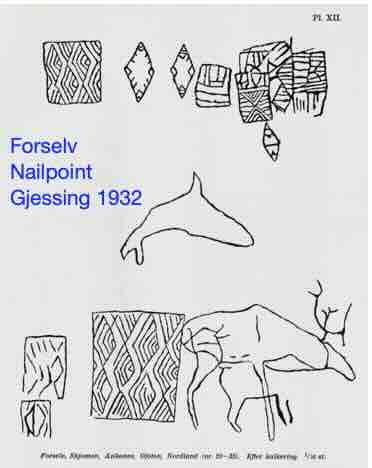
Omrisser 'signed' many of his panels with rhombic designs. The ocher paintings at Fångsjön (Jämtland), knife incisions at Hell (Trøndelag), and nailpoint petroglyps at Forselv (Nordland) have a remarkable 3D-look.
Dynamics of two artists working together
Where Innrisser and Omrisser worked together on the same panel, their images can be rather similar and difficult to distinguish. Omrisser liked working together with Innrisser, but Innrisser was sometimes annoyed that Omrisser was defacing his panels. When Innrisser chased Omrisser away, he often went down the hill to work. I think that was so he could look up at Innrisser. If he went up the hill, he would need to stop working and turn around to look down at Innrisser.
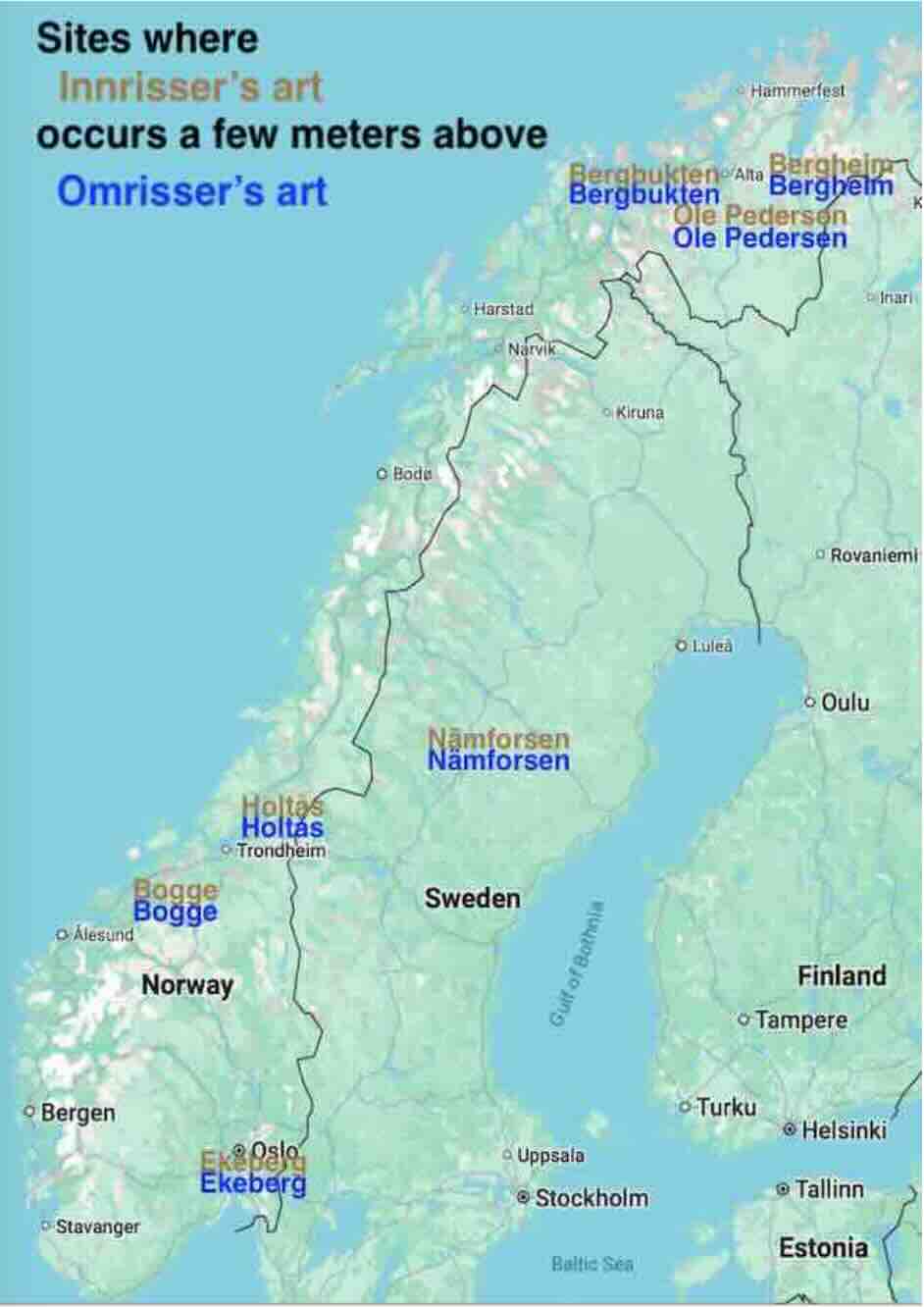
At Ekeberg in Oslo, Innrisser and Omrisser each made four deer. Innrisser’s deer are higher on the panel. They have four legs, tiny heads, two parallel ears, and straight backs without shoulder humps. Omrisser’s deer have two legs, two outlined ears that form a V, and shoulder humps.
At Nämforsen in Sweden, the primary panel provides another typical example.
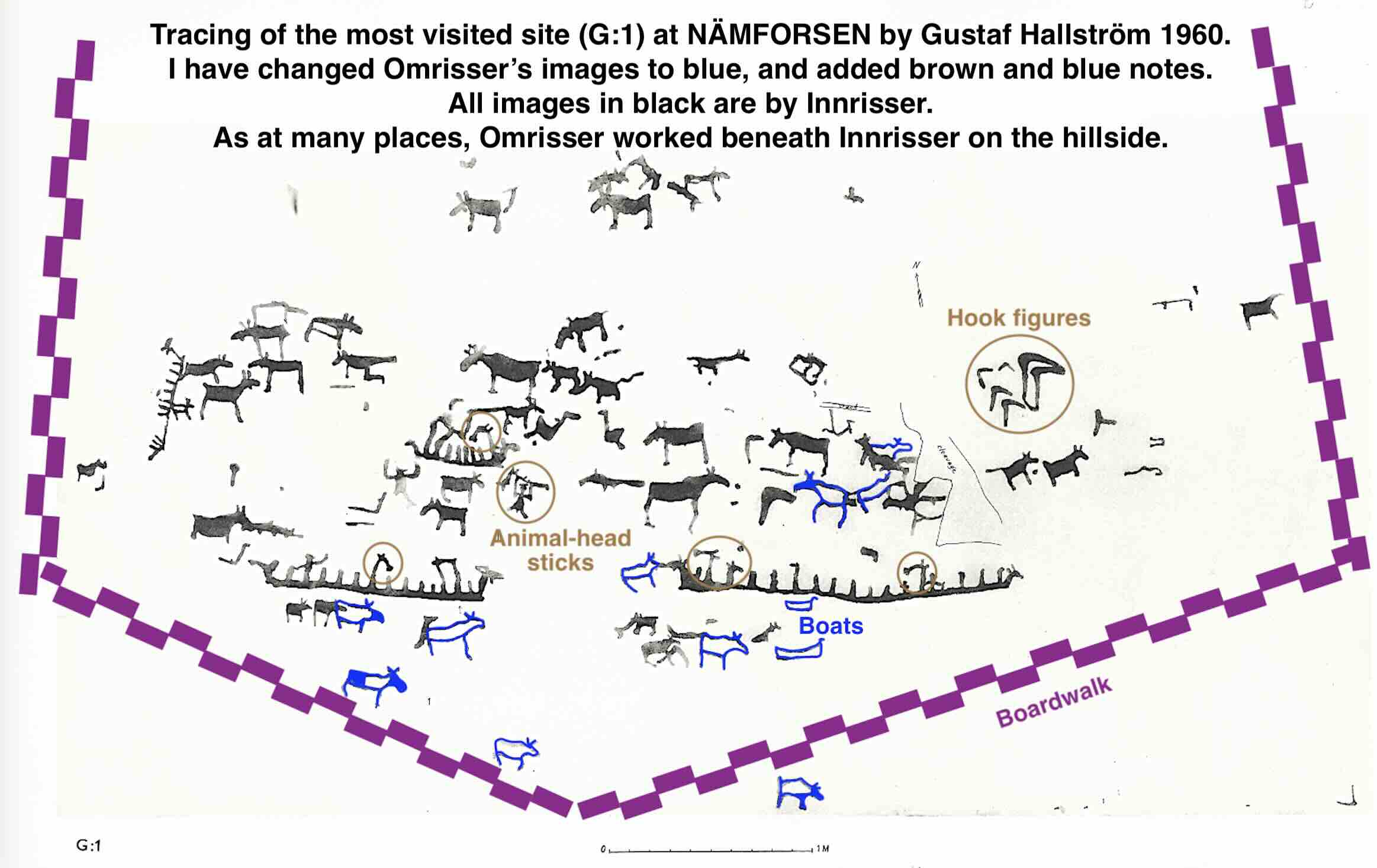
In messages at Groups.io, I have registered Omrisser's art occurring below Innrisser's art: Ekeberg, Bogge, Holtås, and Nämforsen, and in Alta at Bergbukten, Ole Pedersen, and Bergheim. Omrisser liked working closely with Innrisser, but I don't think the feeling was mutual.
Vemundr Vyg
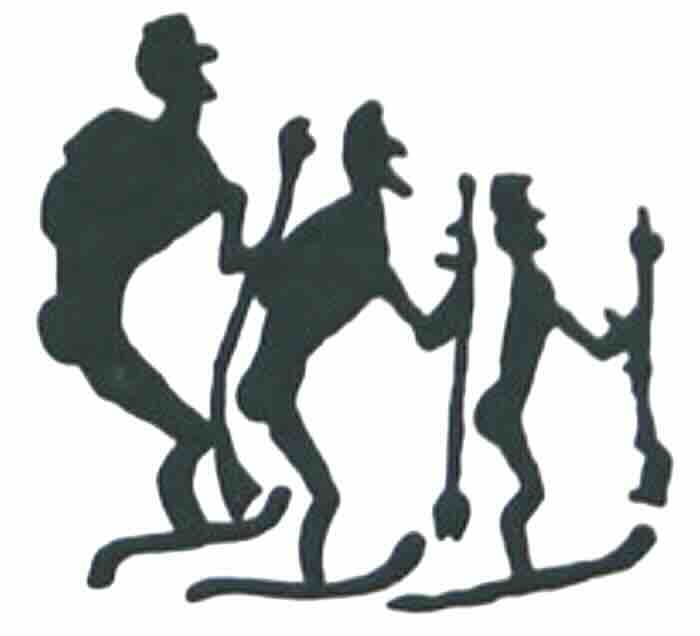
Vemundr Vyg worked at Kanozero and the Vyg River area of the White Sea in Russia. He engraved pre-Viking style boats with animal-head prows, just as Innrisser did. I think he learned the nailpoint engraving technique from seeing Ingi Innrisser's art in northern Norway. Vyg usually drew men in profile, which none of the other artists did. He was mostly interested in hunting: whale hunting with many boats in the White Sea, and bear and moose hunting by men on skis with bows and arrows.
See Vyg's work at Kanozero, Russia
See Vyg's work at Zalavruga, Russia
Runestones were engraved by other artists, who probably used iron chisels with steel edges, like the best Viking swords. There are about 10 runestones in Norway and Sweden with Elder Futhark runes (24 character alphabet). I know of none that include images. There are over 2000 runestones with Futhark runes (16 character alphabet) from the Viking age, 800-1030 CE. Many of these runestones have images, but none resemble the images of Stikkmann, Innrisser, or Omrisser. None have cup glyps.
Petroglyps cannot be dated directly, and that has been a problem, because people expect archaeologists to tell just how old an artifact is. Norwegian archaeologists adopted the 'shoreline dating method' a century ago. Shoreline dating gives the time that the land area rose above the sea during post-glacial uplift. That is the oldest possible time of human activity on that land. It is a geological age, not an archaeological age. It only works if the petroglyps were made right at the shoreline. But I think they would not have been made there. My geology students and I cannot work with slippery shoreline rocks.
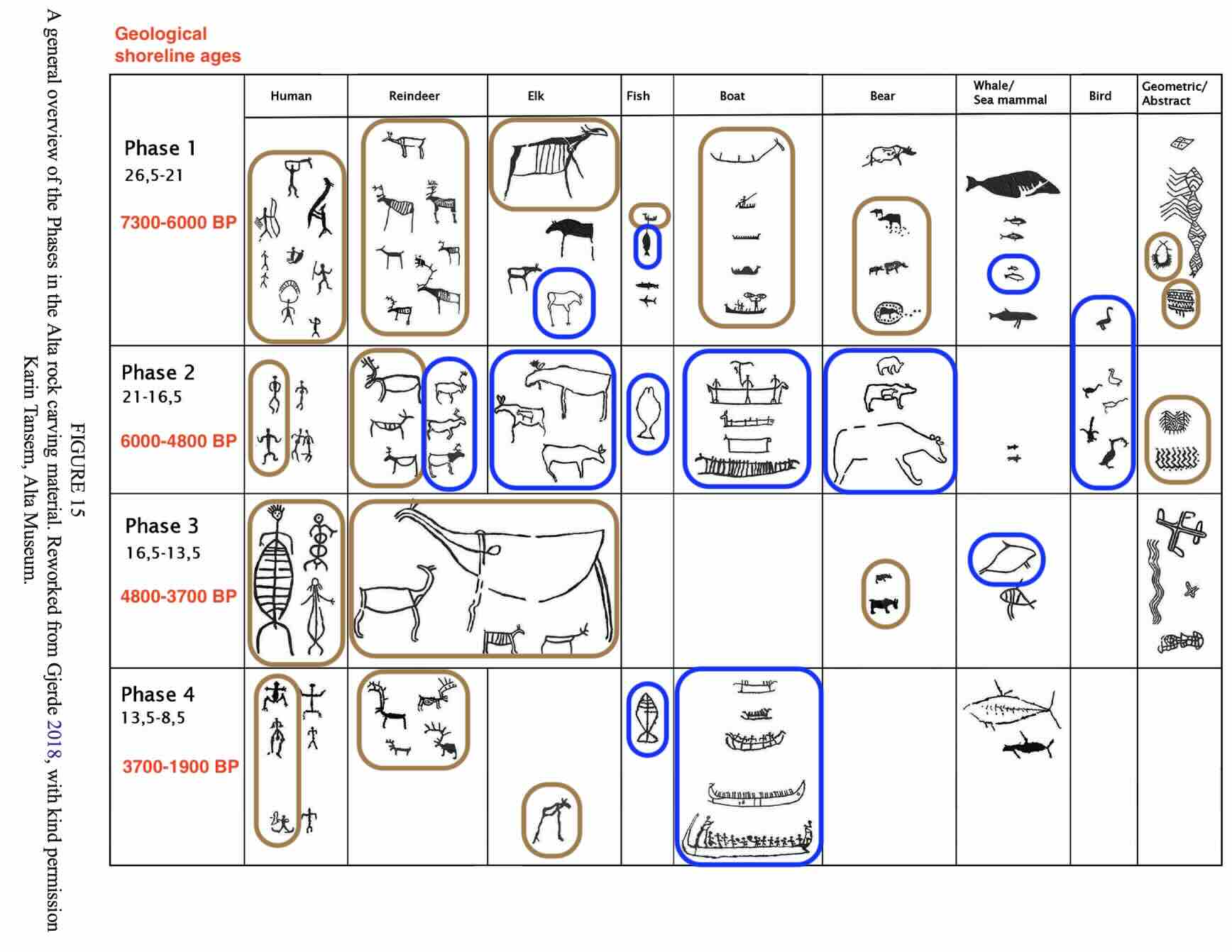
At many petroglyph sites, images high on a hillside are said to be hundreds of years older than similar images a few meters lower down. At Alta, the age difference is said to be over 5000 years. The figure below, from a publication by Jan Magne Gjerde (2024) shows the four supposed phases of rock art at Alta that were established in a publication by Knut Helskog (1988). I have added in red the years BP (Before Present) that are claimed for those phases. The ages apply only to the ancient shore levels, not the images. I ignore the elevations of Alta images, and can identify most of them as the work of either Innrisser (brown) or Omrisser (blue).
Nordic petroglyp artists —why did they do it? Ingi Innrisser’s and Oddr Omrisser’s petroglyps have been called veideristninger, or hunting engravings. Steinn Stikkmann’s petroglyps have been called jordbruksristninger, or farming engravings. Actually, there are very few depictions of hunting or farming. The images have been thought to reflect cults and rituals in the distant past. Now we can imagine other motivations artists might have had for making the engravings.
Innrisser and Omrisser were interested in animals, but not hunting. They were both fascinated by domesticated reindeer. Innrisser showed reindeer corrals, and Omrisser showed reindeer with collars. Stikkmann was mostly interested in ships in Scandinavia, but not in Italy.
Stikkmann liked the physical process of engraving. We can see that, because he engraved the same image so many times: examples are his 70 horses at Fordal (Stjørdal), 400 shoe prints at Leirfall (Stjørdal), and 1000 cup glyps at Stenbacken (Tanum). At Aspeberget (Tanum) he drew a vertical column of 15 boats, all the same. At Cemmo in Valcamonica, he drew vertical columns of the same images: deer, horses, oxen, plowing scenes, and daggers. Engraving the same image again and again was an activity that he enjoyed. And, like Tryggvi Tagger, Stikkmann engraved cup glyps to leave his personal mark at places he visited.
Stikkmann drew a few dramatic scenes in Bohuslän and Valcamonica, such as deer being chased by dogs, and two men dueling. He drew many men with penises, but I think they do not indicate a fertility cult. He almost never drew a woman or a child. He probably drew the penis to indicate male sex. He put penises on horses, bulls, dogs, and deer. Some of Stikkmann's men have exaggerated phalluses and brandish weapons, which seems to indicate they were men of power. Penis images were probably not a big deal in Scandinavia in the Iron Age: Innrisser and Omrisser sometimes drew penises, and so did Vemundr Vyg at Kanozero and Zalavruga. But Stikkmann was especially interested in them.
Innrisser also enjoyed the engraving process. Omrisser, on the other hand, was fond of drawing, but not engraving. He typically did not complete his engravings. For his large life-like animals, such as the 6-meter long whale at Bardal, he must have drawn them, to get the proportions correct, but didn't bother to completely engrave them.
Stikkmann, Innrisser, Omrisser, and Vyg were artists. Stikkmann was also a tagger. Innrisser was sometimes a storyteller, when he documented Sámi and animal activities at Alta. Vyg's main interest was storytelling —stories of whale hunting with fleets of boats, and men on skis hunting bears and moose. Omrisser was mostly an animal naturalist, but occasionally drew good likenesses of humans and boats. We can imagine that the artists also drew on other materials that have not survived.
Allan Krill
allankrill@gmail.com
Click on a site name to see some of the petroglyph images.
Almfjellet, Trøndelag (Omrisser) [ocher technique]
Alta, Finnmark (Innrisser + Omrisser)
Alta Amtmannsnes, Finnmark (Innrisser)
Alta Apanes, Finnmark (Omrisser)
Alta Bergbukten, Finnmark (Innrisser shown in red) (Omrisser shown in blue)
Alta Kåfjord, Finnmark (Innrisser shown in black) (Omrisser shown in blue)
Alta Ole Pedersen, Finnmark (Innrisser + Omrisser)
Arnstad, Trøndelag (Stikkmann)
Askum, Bohuslän +page (Stikkmann) [runes]
Askvoll, Vestland (Stikkmann)
Aspeberget, Bohuslän (Stikkmann)
Aubeberget, Rogaland +page (Stikkmann)
Auran, Trøndelag (Stikkmann)
Ausevik, Vestland (Innrisser)
Backa, Bohuslän +page (Stikkmann)
Bakke, Trøndelag (Stikkmann)
Bakke-Kalhagen (Herand, Jondal), Vestland (Stikkmann)
Balken, Bohuslän (Stikkmann)
Bardal I, Trøndelag (Stikkmann + Omrisser)
Bardal I, Trøndelag (Omrisser, with Stikkmann's work not shown)
Bardal II, Trøndelag (Stikkmann + Omrisser) [39% cup glyps, 21% shoe soles]
Bardal III, Trøndelag (Innrisser)
Bavnehøj, Bornholm (Stikkmann) [99% cup glyps]
Begby, Østfold (Stikkmann)
Berga, Västmanland (Stikkmann)
Berget, Buskerud (Stikkmann)
Bingsfossen, Akershus +page (Stikkmann)
Björksta, Västmanland (Stikkmann)
Bjørngård, Trøndelag (Stikkmann)
Bjørset, Møre og Romsdal (Omrisser?)
Blindern, Oslo (Stikkmann)
Blåholt, Bornholm (Stikkmann) [44% cup glyps]
Bogge (Boggestranda) I, II, III, Møre og Romsdal (Innrisser + Omrisser)
Bogge I, Møre og Romsdal (Innrisser + Omrisser)
Bogge II, Møre og Romsdal (Omrisser)
Bogge III, Møre og Romsdal (Omrisser)
Boglösa, Uppland (Stikkmann)
Boglösaby, Uppland (Stikkmann)
Bokenäs, Bohuslän (Stikkmann) [95% cup glyps]
Borgenveien, Østfold (Stikkmann)
Bornholm, Denmark (Stikkmann)
Brandskog, Uppland (Stikkmann)
Brastad, Bohuslän +page (Stikkmann) [36% cup glyps]
Bremset, Trøndelag (Stikkmann)
Brennholtet, Nordland (Omrisser)
Brillinge, Uppsala (Stikkmann)
Bro, Bohuslän (Stikkmann) [74% cup glyps]
Brobakken (Hvittingfoss), Buskerud (Stikkmann)
Brogård, Bornholm (Stikkmann) [28% cup glyps]
Bru, Rogaland (Stikkmann + Omrisser)
Bruteigsteinen (Etne), Vestland (Stikkmann)
Brændesgård, Bornholm (Stikkmann) [72% cup glyps]
Buøy, Rogaland (Stikkmann)
Bärfendal, Bohuslän (Stikkmann) [57% cup glyps]
Bø, Rogaland (Stikkmann)
Bøla, Trøndelag (Omrisser)
Campo Lameiro, Pontevedra, Spain (Stikkmann)
Capo di Ponte, Valcamonica, Italy (Stikkmann)
Carschenna, Switzerland (Stikkmann)
Cemmo, Valcamonica, Italy (Stikkmann)
Dalbo (Kolsås), Akershus +page (Stikkmann)
Disåsen, Bohuslän (Stikkmann)
Dokkfløyvatnet, Innlandet (Innrisser? + Omrisser?)
Drotten, Innlandet (Innrisser + Omrisser)
Duved (Åresjön), Jämtland (Omrisser)
Egna hem, Norrköping (Stikkmann) [45% cup glyps]
Eidefossen, Innlandet (Omrisser)
Ekeberg (Sjømannsskolen), Oslo (Innrisser + Omrisser)
Ekeberg (Ekebergsletta), Oslo (Stikkmann) [>90% cup glyps]
Ekenberg, Norrköping (Stikkmann)
Emelieborg, Bohuslän (Stikkmann)
Etne, Vestland (Stikkmann)
Evenhus, Trøndelag (Stikkmann + Omrisser)
Evjestien, Østfold (Stikkmann)
Finntorp, Bohuslän (Stikkmann)
Fiskeby, Norrköping (Stikkmann)
Fjøsnaneset, Vestland (Stikkmann)
Flatruet, Jämtland (Omrisser) [ocher technique]
Flatøya, Nordland (Stikkmann)
Fluberget, Rogaland (Stikkmann)
Flyhov, Västergötland (Stikkmann)
Fordal, Trøndelag (Stikkmann)
Forselv (Skjomen), Nordland (Omrisser) [3D rhombic 'signature']
Forshälla, Bohuslän (Stikkmann)
Forså (Efjord), nordland (Omrisser)
Foss, Trøndelag (Stikkmann) [68% cup glyps]
Foss, Bohuslän (Stikkmann) [67% cup glyps]
Fossum, Bohuslän (Stikkmann)
Frännarp, Skåne (Stikkmann) [45% cup glyps]
Fykanvatn, Nordland (Omrisser) [lichen-scraping technique]
Fåglum, Västergötland (Stikkmann) [30% cup glyps, 70% footprints]
Fångsjön, Jämtland (Omrisser) [ocher technique] [3D rhombic 'signature']
Fårö, Gotland (Stikkmann) [58% cup glyps]
Gamnes, Finnmark (Innrisser)
Gardshaug (Ølberg), Rogaland (Stikkmann)
Geithus, Buskerud (Innrisser + Omrisser)
Gerum, Bohuslän (Stikkmann)
Gjettum, Akershus (Stikkmann)
Gjerpen (Løberg, Skien), Telemark (Stikkmann)
Gjeving, Trøndelag (Stikkmann)
Glemmestad, Innlandet (Innrisser + Omrisser)
Glömminge, Småland (Stikkmann) [69% cup glyps]
Glösa, Jämtland (Innrisser)
Granaune, Trøndelag (Stikkmann)
Gravem, Møre og Romsdal (Stikkmann)
Grinneröd, Bohuslän (Stikkmann)
Grødby, Bornholm (Stikkmann) [99% cup glyps]
Gråbrekk, Trøndelag (Stikkmann)
Guifões, Portugal (Stikkmann)
Gärde, Jämtland (Omrisser) [knife-point technique]
Görlöf, Bohuslän (Stikkmann)
Gåshopen, Finnmark (Innrisser)
Hafslund, Østfold (Stikkmann)
Haga, Rogaland (Stikkmann)
Hagen, Trøndelag (Stikkmann)
Hallinge, Stockholm (Stikkmann)
Hamarhaug, Vestland (Stikkmann)
Hammer I, IV, V, VI, VIII, X, XIII, XIV, XV, Trøndelag (Omrisser)
Hammer II, III, XI, Trøndelag (Stikkmann)
Hammer IX, Trøndelag (Stikkmann + Omrisser)
Hammersholm, Bornholm (Stikkmann) [90% cup glyps]
Hananger, Agder (Stikkmann)
Harastad, Rogaland (Stikkmann)
Hasslöv, (Lassahussteinen), Halland (Stikkmann)
Hauge, Rogaland (Stikkmann)
Haugen, Vestfold (Stikkmann)
Hegre, Trøndelag (Stikkmann)
Helgaberget, Vestland (Stikkmann)
Hell, Trøndelag +page, (Omrisser) [knife-point technique] [3D rhombic 'signature']
Hellestø, Rogaland (Stikkmann)
Hemsta, Uppland (Stikkmann)
Hennebygda, Vestland (Stikkmann)
Herand (Jondal, Bakke-Kalhagen), Vestland (Stikkmann)
Herjangen, Nordland (Omrisser)
Herrebro, Norrköping (Stikkmann)
Herrestad, Bohuslän (Stikkmann) [runes, 81% cup glyps]
Himmelstalund, Norrköping +page (Stikkmann) [runes]
Hinna (Honnhammer, Tingvoll), Møre og Romsdal (Omrisser) [ocher technique]
Hjulatorp, Kronobergs län (Stikkmann)
Hodnafjell, Rogaland (Stikkmann)
Hogdal, Bohuslän (Stikkmann)
Holtås I, Trøndelag (Innrisser)
Holtås I, II, Trøndelag (Omrisser)
Hommelvik, Trøndelag (Omrisser)
Hommelvik III (Flathomen, Muruvik), Trøndelag (Stikkmann)
Honnhammerneset (Tingvoll), Møre og Romsdal (Omrisser) [ocher technique]
Hoppestad (Skien), Telemark (Stikkmann)
Horjem, Trøndelag (Omrisser)
Horsahallen, Blekinge (Stikkmann)
Husebø, Agder (Stikkmann)
Hvitlycke, Bohuslän (Stikkmann)
Häljesta, Västmanland (Stikkmann) [50% cup glyps]
Hästhallen, Skåne (Stikkmann)
Hästholmen, Östergötland (Stikkmann) [61% cup glyps]
Hästskotjärn, Jämtland (Omrisser) [ocher technique]
Högadal, Blekinge (Stikkmann)
Högsbyn, Dalsland +page (Stikkmann)
Håby, Bohuslän (Stikkmann) [96% cup glyps]
Håhaugsteinen, Vestland (Stikkmann)
Ilkley Moor, West Yorkshire England (Stikkmann)
Ingstad, Trøndelag (Stikkmann)
Isnestoften (Langnesholmen), Finnmark (Innrisser + Omrisser)
Järrestad, Skåne +page (Stikkmann) [58% cup glyps]
Jätteberget, Älvsborg (Stikkmann)
Jörlov, Bohuslän (Stikkmann)
Kalleberg, Rogaland (Stikkmann)
Kalleby, Bohuslän (Stikkmann)
Kanozero, Russia
Karlsberget, Norrköping (Stikkmann)
Kattaberget (Bø i Sokndal), Rogaland (Stikkmann)
Katthammar, Rogaland (Stikkmann)
Kil, Trøndelag (Stikkmann)
Kivik (King's Grave, Bredarör), Skåne (Stikkmann)
Kjernevik (Kjøbenhavnerbukta), Rogland (Stikkmann)
Klinta, Öland (Stikkmann)
Klockaretorpet, Norrköping (Stikkmann)
Klokkesteinen (Ytterøya), Trøndelag (Stikkmann) [runes]
Krabbestig (Husevågøy), Vestland (Stikkmann)
Krokstad, Bohuslän (Stikkmann) [100% cup glyps]
Kråkenes (Lundeveien), Agder (Stikkmann)
Kråkhaug (Helland), Rogaland (Stikkmann)
Kvennavika, Trøndelag (Omrisser)
Kvernevik, Rogaland (Stikkmann)
Kviljo, Agder (Stikkmann)
Kville, Västergötland +page +page (Stikkmann)
Kyrkstigen, Västergötland (Stikkmann)
Kårstad, Vestland (Stikkmann) [runes]
Ladvik, Stockholm (Stikkmann)
Landverk (Ånnsjön), Jämtland (Omrisser)
Lane-Ryr, Bohuslän (Stikkmann)
Langeland, Rogaland (Stikkmann)
Langnesholmen (Isnestoften), Finnmark (Innrisser + Omrisser)
Leiknes, Nordland (Omrisser) [lichen-scraping technique]
Leirbukt, Finnmark (Innrisser)
Leirfall, Trøndelag (Stikkmann) [11% cup glyps, 41% shoe prints]
Leirvåg, Vestland (Stikkmann)
Leonardsberg, Norrköping (Stikkmann)
Lier (Bygdetun), Buskerud (Stikkmann)
Lier (Utenga), Buskerud (Innrisser + Omrisser)
Lille Strandbygård, Bornholm (Stikkmann) [77% cup glyps]
Litlevåg-Meling (Åmøy), Rogaland (Stikkmann)
Litsleby, Bohuslän (Stikkmann)
Ljung, Bohuslän (Stikkmann)
Lommeland, Bohuslän (Stikkmann)
Lunde, Agder (Stikkmann)
Lur, Bohuslän (Stikkmann)
Lycke, Bohuslän (Stikkmann)
Lyse, Bohuslän (Stikkmann) [47% cup glyps]
Lärbro, Gotland (Stikkmann) [13% cup glyps, 78% shoe prints]
Løkeberget, Bohuslän (Stikkmann)
Løland, Rogaland (Stikkmann)
Lövåsen, Bohuslän (Stikkmann)
Lånke (Tønsåsen), Trøndelag (Omrisser)
Madsebakke, Bornholm (Stikkmann) [81% cup glyps]
Maresø, Bornholm (Stikkmann) [73% cup glyps]
Massleberg, Bohuslän (Stikkmann)
Melhus, Trøndelag (Stikkmann)
Melingsjøvegen (Åmøy), Rogaland (Stikkmann)
Mjønes (Vågan), Nordland (Omrisser) [lichen-scraping technique]
Mo, Bohuslän (Stikkmann)
Molteberghellene, Østfold (Stikkmann)
Mona, Trøndelag (Stikkmann)
Mt. Bego, France +page
Møllerstufossen, Innlandet (Innrisser)
Nag, Rogaland (Stikkmann + Omrisser)
Naquane, Valcamonica Italy (Stikkmann)
Naverstad, Bohuslän (Stikkmann)
Nedre Tasta, Rogaland (Stikkmann)
Nes (Josarsaklubben, Lødingen), Nordland (Omrisser) [lichen-scraping technique]
Nexø (Fandens keglebane), Bornholm (Stikkmann) [97% cup glyps]
Nordbø (Skien), Telemark (Stikkmann)
Norr Edsten 15 (Kville), Bohuslän (Stikkmann)
Norrfors, Norrland +page (Omrisser)
Nytjønna, Trøndelag (Innrisser)
Nämforsen, Västernorrlands län (Innrisser + Omrisser)
Näsinge, Bohuslän (Stikkmann)
Okkenhaug, Trøndelag (Stikkmann)
Ombo (Trettestykkje), Rogaland (Stikkmann)
Onega, Russia
Onsbæk, Bornholm (Stikkmann) [99% cup glyps]
Oppauran, Trøndelag (Stikkmann)
Oppeby, Södermanland (Stikkmann)
Orust, Bohuslän (Stikkmann) [96% cup glyps]
Otterbäcken, Bohuslän (Stikkmann)
Penne, Agder (Stikkmann)
Pontevedra, Galicia Spain (Stikkmann)
Pryssgården, Norrköping (Stikkmann) [100% cup glyps, 520 total]
Pyntelund (Bjørnstadskipet), Østfold (Stikkmann)
Ramberg, Akershus +page (Stikkmann)
Rauhammer, Trøndelag (Omrisser) [ocher technique]
Re, Trøndelag (Stikkmann)
Reitaneset, Møre og Romsdal (Innrisser?)
Rennebu, Trøndelag (Stikkmann) [100% cup glyps]
Revheim, Rogaland (Stikkmann)
Revlan, Trøndelag (Stikkmann + Omrisser)
Rickeby, Uppland (Stikkmann)
Ringeby, Bornholm (Stikkmann) [99% cup glyps]
Roskar (Herøy, Gurskøya), Møre og Romsdal +page (Stikkmann)
Rudlo, Rogaland (Stikkmann)
Rykkje (Kvam), Vestland (Omrisser)
Røkke, Trøndelag (Stikkmann)
Røsand, Møre og Romsdal (Omrisser)
Råhaugen, Østfold (Stikkmann)
Sagaholm, Jönköping (Stikkmann)
Sagelva (Tømmerneset), Nordland (Omrisser) [lichen-scraping technique]
Salsnes (Reppen), Trøndelag (Omrisser)
Salthammeren (Vangdal), Vestland (Innrisser + Omrisser)
Salthammeren (Vangdal) upper panel, Vestland (Omrisser)
Salthammeren (Vangdal) lower panel, Vestland (Stikkmann)
Samnøy, Vestland (Stikkmann)
Sandane (Gloppen, Austrheim), Vestland (Stikkmann)
Sandhalsen, Trøndelag (Omrisser) [ocher technique]
Sandåker, Bohuslän (Stikkmann)
Sanne, Bohuslän (Stikkmann) [100% cup glyps]
Selbustrand, Trøndelag (Stikkmann)
Seradina-Bedolina, Valcamonica, Italy (Stikkmann)
Simrislund, Skåne (Stikkmann)
Sjøhagen-Meling (Åmøy), Rogaland (Stikkmann + Omrisser)
Skavberget 1,2, Troms (Omrisser)
Skavberget 3, Troms (Innrisser + Omrisser)
Skee, Bohuslän (Stikkmann)
Skepplanda, Bohuslän (Stikkmann)
Skien (Gjerpen), Telemark (Stikkmann)
Skogerveien, Buskerud +page (Innrisser)
Skredsvik, Bohuslän (Stikkmann) [75% cup glyps]
Skälv, Norrköping (Stikkmann)
Slagsta, Södermanland +page (Stikkmann) [84% cup glyps]
Slavlo, Trøndelag (Stikkmann)
Slettjord, Nordland (Omrisser)
Slettnes, Finnmark (Innrisser)
Sola, Rogaland (Stikkmann)
Solbakk, Rogaland (Stikkmann)
Solberg, Østfold +page (Stikkmann)
Sotorp, Bohuslän (Stikkmann)
Sporanes (Sporaneset, Rauland), Telemark (Stikkmann)
St Almegård, Bornholm (Stikkmann) [99% cup glyps]
Stavenes (Staveneset, Askvoll, Unneset, Mjåset), Vestland (Stikkmann)
Steinsodden (Stein, Steinsholmen), Innlandet (Innrisser) (+Omrisser)
Stokkan, Trøndelag (Stikkmann)
Storløkkebakke, Bornholm (Stikkmann) [69% cup glyps]
Storsteinen Alta, Finnmark (Innrisser) (+Omrisser)
Strand, Trøndelag (Omrisser)
Stuberg (Støberg), Trøndelag (Stikkmann) [runes]
Stugåsberget, Älvsborg (Stikkmann)
Stykket, Trøndelag (Omrisser)
Sundvollen, Buskerud +page +page (Stikkmann)
Surnadal, Møre og Romsdal (Innrisser)
Svanhalla, Blekinge (Stikkmann)
Svarteborg, Bohuslän (Stikkmann) [57% cup glyps]
Sverstad Søndre, Vestfold (Stikkmann)
Søbstad, Møre og Romsdal (Omrisser)
Sør-Sunde, Rogaland (Stikkmann)
Tanum, Bohuslän (Stikkmann)
Tegneby, Bohuslän (Stikkmann)
Tennes (Bukkhammaren), Troms (Innrisser
Tennes (Gråberget), Troms (Innrisser + Omrisser)
Tennes (Kirkely), Troms (Innrisser + Omrisser)
Tessem, Trøndelag (Stikkmann) [runes]
Tjursåker, Uppland (Stikkmann)
Tjøtta (Tro, Rødøya), Nordland (Stikkmann)
Tjøtta (Valen, Rødøya, Røøyen), Nordland (Omrisser)
Torhamn, Blekinge (Stikkmann)
Torsbo, Bohuslän (Stikkmann)
Tose, Bohuslän (Stikkmann)
Tossene, Bohuslän (Stikkmann)
Ullshelleren/Valldalen, Vestland (Stikkmann)
Unneset, Vestland (Stikkmann)
Utsikten-Alvim, Østfold (Stikkmann)
Ulvudden (Värmlandsnäs), Värmland (Stikkmann)
Valcamonica, Italy (Stikkmann)
Valla, Bohuslän (Stikkmann)
Valle (Finnhågen, Efjord), Nordland +page +page (Omrisser)
Vallen, Västmanland (Stikkmann)
Valtellina, Italy (Stikkmann)
Vangdal (Salthammeren), Vestland (Innrisser + Omrisser)
Verdal, Trøndelag (Omrisser)
Vigdel, Rogaland (Stikkmann)
Vik on Rolla, Troms (Omrisser)
Vikan, Trøndelag (Stikkmann)
Vitlycke, Bohuslän (Stikkmann)
Vingen, Vestland (Innrisser)
Vinja, Vestland (Stikkmann)
Vistnesdalen (Vistnes, Vevelstad), Nordland +page (Omrisser)
Vrångstad, Bohuslän (Stikkmann) [77% cup glyps]
Vågholmveien, Rogaland (Stikkmann)
Ydstines, Trøndelag (Stikkmann)
Ytterøya, Trøndelag (Stikkmann) [runes]
Zalavruga (Vyg), Russia
Ølbør, Rogaland (Stikkmann)
Örsta, Uppland (Stikkmann)
Åbodsjön, Ångermanland (Omrisser) [ocher technique]
Åby, Bohuslän+page (Stikkmann)
Åby, Norrköping (Stikkmann) [22% cup glyps]
Åkirkeby (Fandens keglebane), Bornholm (Stikkmann) [94% cup glyps]
Åmøy, Rogaland (Stikkmann + Omrisser)
Åmøy (Meling), Rogaland +page +page (Stikkmann)
Åmøya (Klubba), Nordland +page (Omrisser) [lichen-scraping technique]
Årby, Västmanland (Stikkmann)
Ås (Skien), Telemark (Stikkmann)
Åskollen, Buskerud (Innrisser)
Åsvittinge, Norrköping (Stikkmann) [97% cup glyps]
Internet resources.
Kulturminnesøk, Norway.
The Megalithic Portal.
Rupestre.net: Rock Art in the Alps.
Stiftelsen för dokumentation av Bohusläns hällristningar.
Swedish Rock Art Research Archives.
Swedish Rune Map.
Multi-site descriptions. (More references).
Engelstad, Eivind, 1934. Østnorske ristninger og malinger av den arktiske gruppe.
Fett, Eva N. & Per Fett, 1941. Sydvestnorske helleristninger: Rogaland og Lista.
Gjerde, Jan Magne, 2010. Rock art and landscapes. Studies of Stone Age rock art from Northern Fennoscandia.
Gjessing, Gutorm, 1932. Arktiske helleristninger i Nord-Norge.
Gjessing, Gutorm, 1936. Nordenfjelske ristninger og malinger av den arktiske gruppe.
Hagen, Anders, 1965. Rock Carvings in Norway.
Hagen, Anders, 1976. Bergkunst: Jegerfolkets helleristninger og malninger i norsk steinalder.
Hagen, Anders, 1990. Helleristningar i Noreg.
Helberg, Bjørn Hebba, 2016. Bergkunst nord for Polarsirkelen.
Helskog, Knut, 1988. Helleristningene i Alta.
Hygen, Anne-Sophie & Lasse Bengtsson, 1999. Helleristninger i grensebygd: Bohuslän og Østfold.
Hygen, Anne-Sophie & Lasse Bengtsson, 2000. Rock Carvings in the Borderlands: Bohuslän and Østfold.
Mandt, Gro & Trond Lødøen, 2005. Bergkunst. Helleristningar i Noreg.
Mandt, Gro & Trond Lødøen, 2010. The Rock Art of Norway.
Mandt Larsen, Gro, 1972. Bergbilder i Hordaland.
Marstrander, Sverre & Kalle Sognnes, 1999. Trøndelags jordbruksristninger.
Mikkelsen, Egil, 1977. Østnorske veideristninger: Kronologi og øko-kulturelt miljø.
Moe, Steinar & Einar Østmo, 1994. Norske helleristninger.
Simonsen, Povl, 1958. Arktiske helleristninger i Nord-Norge II.
Sognnes, Kalle, 1999. Det levende berget.
Sognnes, Kalle, 1999. Helleristninger i Stjørdal.
Tansem, Karin, 2022. Helleristningene i Alta: Estetikken, geologien og figurene.
Vogt, David, 2012. Østfolds helleristninger.
The links below explain my evidence and hypotheses (including hypotheses that I have abandoned).
Index of the website https://groups.io/g/VikingRockArt
400. Re: Steinn Stikkmann drew Norwegian-style lofts in Valcamonica (6/2026)
399. Re: Stikkmann’s birthplace was probably Foss in Gauldalen, central Norway (6/2026)
398. Stikkmann’s trail of foot glyps from Foss to Stjørdal (6/2026)
377/397. Re: Paddles became Stikkmann's favorite doodle image in Valcamonica (6/2026)
396. What inspired Steinn Stikkmann to start engraving rocks? (6/2026)
395. Re: Stikkmann's birthplace was probably Foss in Gauldalen, central Norway (6/2026)
394. Map of the known rock-art sites of Oddr Omrisser (5/2026)
393. Map and nailpoint art by Ingi Innrisser (5/2026)
391. Who painted pictures like this on rock walls in Norway? (5/2026)
385. Hommelvik petroglyphs, 20 km east of Trondheim (5/2026)
382. Steinn Stikkmann made petroglyphs in the Pontevedra area (Galicia Spain) (3/2026)
378. Steinn Stikkmann drew Norwegian-style lofts at Valcamonica (3/2026)
377. Paddles became Stikkmann's favorite doodle image at Valcamonica (2/2026)
376. Do Valcamonica petroglyphs really depict village life in the Alps? (2/2026)
375. Steinn Stikkmann reworked his Swedish hunting-motif many times in Italy (2/2026)
374/380. These geology students are not praying (2/2026)
372. Distinctive birds migrated with Steinn Stikkmann from Sweden to Italy (2/2026)
361/370/373. Similar plowing scenes at Tanum and Valcamonica (2/2026)
369. Stikkmann’s images at Aspeberget (Tanum) and Cemmo (Valcamonica) (2/2026)
368. Stikkmann’s route from the Ligurian Sea to the Western Alps and the Eastern Alps (2/2026)
367. Steinn Stikkmann's horse-and-chariot motif in Aussois, Western Alps (2/2026)
365. Longship voyages by Scandinavian petroglyph artists (2/2026)
364. Two types of Camunian roses: Camunian swastikas and Camunian Xs (2/2026)
362. 1294 shoe-prints and footprints have been found at Valcamonica (2/2026)
360. Man standing on a horse at Valcamonica and Tanum (2/2026)
359. Dueling men as a motif at Tanum and Valcamonica (2/2026)
358. Find 22 birds at Tanum (2/2026)
357/384. Exposed men with spears at Tanum and Valcamonica (2/2026)
355. Steinn Stikkmann’s deer at Bohuslän (Sweden) and at Valcamonica (Italy) (2/2026)
354. 10,000-years of petroglyphs at Valcamonica is simply wishful thinking (2/2026)
353. Stikkmann’s 'Camunian roses' in Bohuslän Sweden and Valcamonica Italy (2/2026)
352. Steinn Stikkmann’s made thousands of petroglyphs at Valcamonica, Italy (1/2026)
350. Map of Steinn Stikkmann’s cup marks and petroglyphs in Sweden (1/2026)
348. Gutorm Gjessing fooled the ski-world for 90 years (1/2026)
345. Steinn Stikkmann’s men with calf-muscles and no biceps (1/2026)
343. Stikkmann's slimline horses in Norway (1/2026)
342. January 2026 status report for Helleristninger.com (1/2026)
340. Re: Distinctive images: 2-wheeled cart pulled by 2 thin horses, by Steinn Stikkmann (1/2026)
337. Innrisser’s story elements at Ole Pedersen, Bergheim, Bergbukten, and Kåfjord in Alta (12/2025)
335/338. Guide to helleristninger at Apana Gård, Alta (12/2025)
333/336. Guide to helleristninger at Bergheim, Alta (12/2025)
332. Guide to helleristninger at Ole Pedersen, Alta (12/2025)
328/329/330. Can you find Omrisser's reindeer within Innrisser's herd? (11-12/2025)
327. Omrisser and Innrisser at the five main sites of Hjemmeluft, Alta (11/2025)
323/326. Guide to helleristninger at Bergbukten Alta (11/2025)
321/325. Guide to Nämforsen hällristningar (11/2025)
324. Guide to helleristninger at Bogge (11/2025)
322. Guide to helleristninger at Sjømannskolen (Ekeberg) Oslo (11/2025)
316/319. Who made which engravings at Nämforsen? (11/2025)
261/320. Innrisser’s powerful animal-head sticks (Alta, Vingen, and Nämforsen) (11/2025)
312. Steinn Stikkmann visited only one island in Bohuslän (Orust) (10/2025)
311. Stikkmann liked the looks of Bronze Age axes (but drew them in the Iron Age) (10/2025)
310/313. Why are there no petroglyphs on the islands in the Tanum-Kville area? (10/2025)
309/315. Steinn Stikkmann's sites in Denmark (10/2025)
308. Sagaholm and Bredarör are Bronze Age monuments, decorated by Stikkmann in about 400 AD
307. Brandskogsskeppet may have been an engraved copy of another artist’s drawing (9/2025)
293/296/306. Steinn Stikkmann's sites in eastern and southern Sweden (5/2025)
305. Steinn Stikkmann wanted his art to be seen and appreciated (9/2025)
304. List of references for Scandinavian rock art (9/2025)
303. Archaeologists have never found chips from supposed stone pecking tools (6/2025)
302. Steinn Stikkmann visited Tjøtta, north Norway’s main pre-Viking settlement (6/2025)
301. Steinn Stikkmann left boats, cup marks, and runes on Ytterøya (6/2025)
300. Map of Steinn Stikkmann's travels (6/2025)
298/299. Fluky site locations: Absence of evidence is evidence of absence (5/2025)
297. I now know of runes at six of Steinn Stikkmann’s petroglyph sites (5/2025)
294. Differing mindsets in geology and archaeology (5/2025)
290. Rennebu and Gravem petroglyphs show that Stikkmann began his long journey on foot
289. Steinn Stikkmann left his mark on the island Bornholm (4/2025)
287. "Same ship, different day" (4/2025)
286. Mostly cup marks on Orust, because there is no Bohus Granite there (4/2025)
285. Percentages of Stikkmann’s figures at sites in Bohuslän, and at Lista, Leirfall, & Foss
284. Steinn Stikkmann made a U-turn at the southern tip of Norway (4/2025)
283. Only three traveling artists (not four) (4/2025)
282. Steinn Stikkmann loved engraving cup marks (4/2025)
281. Sites in Bohuslän with swastikas and Elder Futhark runes by Steinn Stikkmann (4/2025)
279. The maypole (majstången) of Tanum was probably not engraved by Steinn Stikkmann
278. Stikkmann’s art at Kivik is from about 400 CE, but the monument is probably older
277. Tryggvi Tagger probably learned nailpoint technique from Stikkmann at Børve
276. Innrisser and Omrisser were together at Glemmestad (2/2025)
275. Stikkmann’s phalluses were about masculinity and power, not fertility (2/2025)
274. Innrisser and Omrisser were together at Ekeberg, Oslo (2/2025)
273. Innrisser and Omrisser were together at Salthammeren, Hardangerfjord (2/2025)
272. Petroglyph sites record Stikkmann’s journey from Bergen to Stavanger to Telemark
271. Four traveling graffiti artists and one traveling graffiti tagger (2/2025)
270. Petroglyph sites show how Stikkmann traveled from Skien to the Bohus Granite (4/2025)
269. At Bardal, Innrisser’s deer got humps and bigger heads (2/2025)
268. How Innrisser's deer (finally) got their humps (2/2025)
267. At Selbustrand, I imagine Stikkmann thinking: 'These boulders are like from heaven!'
264. Innrisser and Omrisser were together on the island Langnesholmen in Altafjorden
263. Ingi Innrisser’s early styles of drawing humans at Vingen, Storsteinen, and Amtmannsnes
262. Ingi Innrisser’s birthplace was probably Skatestraumen near Vingen (1/2025)
261. Innrisser’s powerful animal-head sticks (Alta, Vingen, and Nämforsen) (1/2025)
258. Oddr Omrisser’s birthplace was probably between Strömsund and Nämforsen, Sweden
257/259. Porpoise images show that Omrisser visited Tennes early in his career (1/2025)
256. Stikkmann’s birthplace was probably Foss in Gauldalen, central Norway (1/2025)
ResearchGate PDF with links to 220 petroglyph sites (12/2024)
220/252. Elder Futhark runes (c. 400 AD) at Stuberg, Tessem, & Kårstad, by Stikkmann
248/249/250. Stikkmann preferred Iddefjord (Bohus) Granite panels for his petroglyphs
247. Petroglyphs in Skien, tracings by Marstrander (1969) (12/2024)
246. Examples (2) of petroglyphs from the book 'Hällristningar och Kultbruk'
245. Examples of petroglyphs from the book 'Hällristningar och Kultbruk' by Almgren (1927)
244. Stikkmann's petroglyphs date the Kivik King's Grave to about 400 CE (12/2024)
242. Petroglyphs of supposed 'Bronze Age boats' are all from the Iron Age (12/2024)
241. Distinctive images: Another huge Stikkmann longship discovered this month (11/2024)
238. Ingi Innrisser could have made all the 'Østnorske veideristninger' in a single summer
237. Distinctive images: Outlines of bears, by Oddr Omrisser (11/2024)
236. Alphabetical list of petroglyph sites and artists (11/2024)
235. The rock art painting motifs in Finland are very different than those in northern Sweden
234. Ramqvist map shows limited motifs of ocher petroglyphs in northern Sweden (11/2024)
233. Map from Jamtli.com of all known ocher-paint petroglyph sites in northern Sweden
232. Ocher-paint petroglyphs in Mid-Norway (11/2024)
231. Distinctive images: Porpoises, by Oddr Omrisser (11/2024)
230/239. Omrisser made ocher paintings in Sweden in winter, standing on ice-covered lakes
226/227/228/229. Did Innrisser carve the 'Surnadal man' before or after the 'Ausevik men'?
225. Stikkmann traveled to Østfold-Bohuslän via Sporaneset, missing Aust-Agder (11/2024)
224. Maps of Bårdr Båtmann's sites in Stavanger and SW Norway, from Fett & Fett (1941)
223. Oddr Omrisser’s sites and works in Mid Norway and Sweden (11/2024)
222. Stikkmann, Båtmann, Innrisser & Omrisser were 'pre-Viking Banksys'
221. Distinctive images: A big fish (by Omrisser) on top of petroglyphs at Alta and Stavanger
219. How could one artist produce petroglyphs at 2700 sites in the Østfold-Bohuslän area?
216. Distinctive images: Deer looking back, by Oddr Omrisser (11/2024)
214/217. Distinctive images: A few 'giants' on a longship, by Steinn Stikkmann (11/2024)
213/215. Distinctive images: Complex scenes, by Ingi Innrisser (10/2024)
212/260. Distinctive images: Large, naturalistic animals, by Oddr Omrisser (10/2024)
211/340. Distinctive images: Chariot pulled by 2 thin horses, by Steinn Stikkmann (10/2024)
209. Distinctive images: Isolated deer head, by Oddr Omrisser (10/2024)
208. Distinctive images: Man approaching tiny woman from behind, by Oddr Omrisser
207. Distinctive images: Rhombs with 3D effect, by Oddr Omrisser (10/2024)
206/243. Distinctive images: Processions, by Steinn Stikkmann (10/2024)
204. Map of sites where 4 petroglyph artists worked, and 3 areas with no known petroglyphs
199. Petroglyphs tell about the 'Pre-Viking Age' in Scandinavia (10/2024)
198. Photos from Bøe (1932) show that a sharp point was used to peck Vingen petroglyphs
197. 'Omrisser' (Outliner) never visited Vingen (10/2024)
196. All the helleristninger at Vingen were made by one visiting artist: 'Innrisser' (10/2024)
195. 'Inliner' may have used boat nails from Slettnes III at Slettnes IV (5/2024)
194. Inliner's work now recognized on boulders at Slettnes (5/2024)
193. Stickman (the first) and Outliner (the last) of the great petroglyph artists (12/2023)
191. Lecture on Stickman and Outliner (20 figures) (11/2023)
(Video) Lecture on Stickman and Outliner (first 40 seconds in Norwegian)
190. Map of 90 petroglyph sites and typology used to identify 7 artists (10/2023)
181. Red-ochre painting at Tingvoll and at Fångsjön: a fourth technique used by Outliner
178. Map of 90 sites where petroglyph artists worked, and 3 areas where none are known
173. Stickman may have made all of the petroglyphs in the Østfold-Bohuslän area (8/2023)
172. Why are there no known petroglyph sites in Aust-Agder? (8/2023)
171. Outliner's large humans at Alta, Bardal, Bøla, Evenhus, Forselv, and Lånke (8/2023)
170. Futhark runes and a swastika independently date the Kårstad petroglyphs to 400 AD
165. Kårstad petroglyphs (200-500 AD) show runes and Hjortspring-style boats (7/2023)
163. Outliner learned to draw longships at Stavanger and then drew them at Alta
161. At Bogge, chasing after petroglyph artists (7/2023)
158. Longship and boat petroglyphs at Apana gård Alta (7/2023)
155. Matching images at 9 and 23 meters above sea level at Alta (7/2023)
121/154. Lumpers and splitters: I am a lumper, whereas archaeologists have refused to lump
152. Who made the longships of Iron-Age-style at Apana, Alta? (7/2023)
148. Learn to recognize Outliner's boats (7/2023)
147. "...depictions comparable to the South Scandinavian Bronze Age and Iron Age boats"
146. Bergbukten 1 (Alta): two artworks for the price of one (7/2023)
141/145. Inliner's 'nailpoint' reindeer at Apana gård (8-10 m. above present sea level) (7/2023)
144. The famous petroglyph 'Man on skis' was probably a man standing in a boat
143. Two 'owners' of reindeer at Bergbukten 4B Alta ('Inliner' and 'Outliner') (7/2023)
142. Animal-head sticks and animal-head boats in Alta petroglyphs (7/2023)
140/149/153. Map of six petroglyph artists and sites where they worked (3) (7/2023)
139. Amtmann — another petroglyph artist that can be recognized at Alta (7/2023)
137/138. A few hours' work by Outliner at Kåfjord, Alta (2) (7/2023)
136/150. Outliner carved petroglyphs on top of previous artworks at Bogge, Bardal, Alta
133. Outliner's petroglyphs are easy to recognize, and found only in the north (2) (7/2023)
132. Stykket is an example of 'distressed' art by Outliner (7/2023)
131. Petroglyphs at Leiknes: rock art from one year, or from five hundred years? (2) (7/2023)
130. Petroglyphs at Alta that I ascribe to Outliner and Inliner (tracings in the book by Helskog)
128. Some petroglyph moose at Alta that I ascribe to Outliner and Inliner (7/2023)
126. Some petroglyphs in central Scandianvia that I ascribe to Outliner and Inliner (7/2023)
124. Outliner's petroglyphs are easy to recognize, and found only in the north (7/2023)
123. Outliner drew 'bulging' eyes at Brennholtet and Leiknes, and unique mouth lines (7/2023)
122. Iron longship nails were ideal for making 'nailpoint' petroglyphs (7/2023)
120. Photos taken at Tennes (Gråberget, Balsfjord) in northern Norway (6/2023)
118. Photos taken at Tennes (Kirkely, Balsfjord) in northern Norway (6/2023)
117. Photos taken at Tennes (Bukkhammaren, Balsfjord) in northern Norway (6/2023)
116. Petroglyphs at Leiknes: rock art from one year, or from five hundred years? (6/2023)
115. No petroglyphs or Viking artifacts have been found in Finland (6/2023)
114. Outliner's nailpoint art at the Ole Pedersen site, Hjemmeluft, Alta (6/2023)
113. Why my manuscripts were rejected by the journals ‘Viking’ and ‘Primitive Tider (6/2023)
112. Stickman's early showpiece at Leirfall is currently closed to the public (6/2023)
109. Outliner's elegant pose: deer looking backward (6/2023)
108. Close-up photos of Inliner's 'nailpoint art' at the Ole Pedersen site, Hjemmeluft, Alta
106. Map of five petroglyph artists and sites where they worked (6/2023)
103. Outliner 'scraped' his petroglyphs in Nordland (he did not 'polish' them) (6/2023)
102. Ismo Luukkonen shows petroglyphs of 83 Scandinavian sites for you to study at home
101. Outliner's reindeer and moose at Fykanvatnet, near Glomfjord (6/2023)
100. Outliner's scraped moose petroglyph at Mjønes (Vågan) (6/2023)
99. Outliner's reindeer and man at Bøla, near Steinkjer (6/2023)
98. Outliner's 'design-signature' at Hell (near Stjørdal) and Forselv (near Narvik) (6/2023)
97. Inliner's 'nailpoint art' at Kåfjord, Alta (6/2023)
96. Outliner's 'nailpoint art' in a one-man show at Apanes, Alta (6/2023)
95. No petroglyphs are found in suitable rocks near the shorelines (why not?) (6/2023)
93. Map of three main petroglyph artists (6/2023)
92. It was typical of Outliner to ignore the feet (5/2023)
91. Alta - Kåfjord petroglyphs seem to show early Sámi culture and early Viking culture
89. Distinguishing between Inliner's work and Outliner's work at Alta (5/2023)
87 & 88. Outliner drew collars on some of his reindeer (2) (5/2023)
86. A boat with a square sail (5/2023)
85. Sámi people lived with domesticated reindeer also before Viking times (5/2023)
84. Stickman trained in soft sedimentary rocks in the Stjørdal area (5/2023)
82. Outliner used three different techniques to outline bodies and body parts (5/2023)
81. Three artists made nearly all the petroglyphs around Trondheimsfjorden (5/2023)
80. Runes and petroglyphs at Ystines / Ydstines near Stjørdal (5/2023)
79. Petroglyph artists probably spoke a Scandinavian language (5/2023)
78. Inliner probably traveled to Ekeberg (Oslo) by boat, not by foot (5/2023)
77. Artist's names are not set in stone (5/2023)
76. Digital caliper: a new tool for describing petroglyphs (5/2023)
75. A paradigm for Scandinavian petroglyphs (manuscript to journal Primitive Tider) (5/2023)
66. Shoe prints. Artists often learn or copy from others (2/2023)
64. Names of places where petroglyph artists exhibited their work (2/2023)
62. Five petroglyph artists recognized by their motifs and artistic styles (manus. in prep)
61. An alternative interpretation of some petroglyphs in Finnmark (manus. to journal Viking)
59. Boats with animal heads among petroglyphs at Peterborough Canada (1/2023)
56. Vikings visited many coasts and rivers in their longships (1/2023)
55. Petroglyphs in Peterborough Canada, probably made by a Viking artist (1/2023)
53. "Shoreline dates" are not really dates at all. Better to call them "Shore maximum ages"
52. Hard rocks can't be engraved using stone-age tools. Most Scandinavian rocks are hard.
51. A simple explanation for petroglyph cup marks (12/2022)
45-49. 'Iron-age Banksys': how widely did they spread their wall-art? (5) (11/2022)
44. Most petroglyphs were made within sight and shouting distance of the shoreline (11/2022)
43. Petroglyph shoreline dates should be referred to as «shore-limiting dates» (11/2022)
42. Lichen grows on all exposed rocks in Norway (11/2022)
39. Shoreline dating improperly used to date Vyg whale hunting (11/2022)
38. Petroglyph evidence for cultural exchange between Vikings and Sámi (11/2022)
36. Nämforsen petroglyphs supposedly show a 4000-year spread of carvings (7/2023)
34. Petroglyph artists (300-800 AD) were Scandinavian and did not visit Finland (11/2022)
33. What does this strange petroglyph really show? (11/2022)
32. Spoiler alert: my musings kill good stories and eliminate fun puzzles (11/2022)
31. Arctic summer hunting trips, destination Alta (11/2022)
30. The Gamnes petroglyph and knapped-flint site can be no older than 1700 years
29. See how flint arrowheads are knapped (Youtube) (11/2022)
27. Newly discovered petroglyphs at 26 m show shoreline-dating gives us falsely old ages
26. Grahame Clark (1975): The Earlier Stone Age Settlement of Scandinavia (11/2022)
24. How 'shoreline dating' has been used for Alta petroglyphs (11/2022)
21. A petroglyph of a longship with an animal-head prow nails its age (11/2022)
20. Biases maximize the age and archaeological value of Leirfall petroglyphs (11/2022)
19. The Professor's Old Claims (12/2022)
17. A Viking-age neck ring (torc) brought to Alta and abandoned there (11/2022)
16. Why Alta petroglyphs do not include women and children (11/2022)
15. "Here's our stuff. Ready to use again this summer!" (11/2022)
14. 30 rowers (15 pairs) in a longship in Alta (11/2022)
13. Ships with an animal-head prow, manned by long-distance rowers (10/2022)
12. The Kvalsund ship from 780 AD resembles an Alta petroglyph (10/2022)
11. The Hjortspring boat (350 BCE) had a crew of 20 rowers. It was built without nails
10. Alta petroglyph boats. Myth vs. reality (10/2022)
9. Could Alta boats really have been made before iron nails were available? (10/2022)
8. The words "Viking" and "Iron" are taboo in publications on Nordic petroglyphs
7. Lødøen (2015) on the experimental production of petroglyph images using a stone tool
6. The petroglyph artist at Storsteinen had no "sketchbook", only one "page" to draw on
5. Deep narrow engravings could not have been made before metal chisels were available
4. Bård Amundsen's article on the Viking-like culture that is said to be over 3000 years old
3. Jan Magne Gjerde (2010) Rock art and landscapes (10/2022)
2. Alta rock art is probably Viking rock art (10/2022)
1. Boat petroglyphs at Alta, Norway (photos at Donsmaps.com) (10/2022)
Allan Krill
allankrill@gmail.com